
1. Industry Background and Development Trends
1.1 Overall Fitness Industry Landscape in China
By 2025, China’s fitness industry market size is expected to exceed RMB 250 billion, with Tier-1 cities accounting for approximately 45% of total market value. Fitness penetration in Tier-1 cities has reached 18.3%, significantly higher than the 6.7% average in lower-tier markets.
From a policy perspective, China’s National Fitness Plan mandates full coverage of fitness facilities at the county level by 2028, with increasing fiscal subsidies directed toward lower-tier cities and county markets. This policy direction is expected to stimulate continuous growth in new fitness venues across China’s “sinking markets.”
Despite ongoing structural changes, traditional commercial gyms still account for roughly 58% of the physical gym market in 2025. These facilities typically operate under a capital-intensive model, with:
• Average club size: 800–1,500 m²
• Heavy reliance on long-term memberships
• Personal training services contributing 35–45% of total revenue
This revenue structure results in a relatively high average debt ratio of around 65% across the sector.
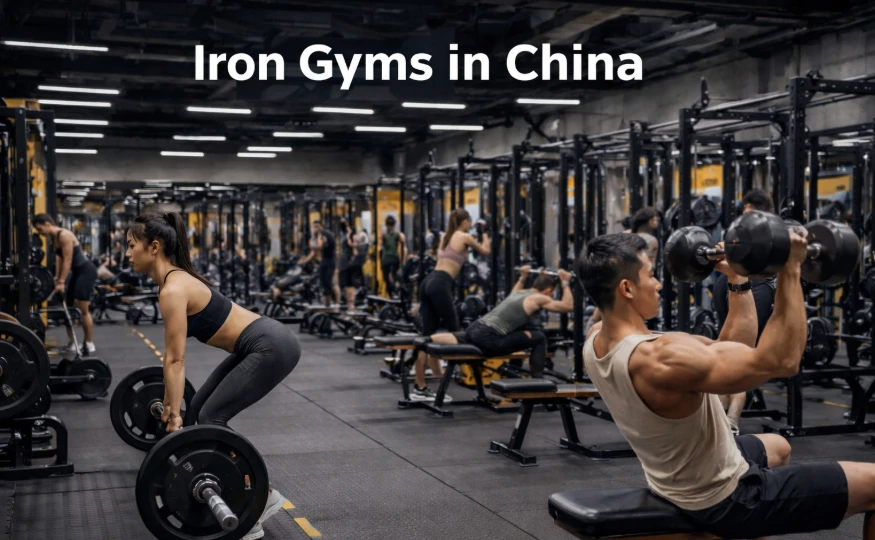
1.2 Why Strength-Focused “Iron Gyms” Are Gaining Momentum
The resurgence of strength-focused gyms—often referred to as “Iron Gyms”—is largely a reaction against the over-commercialization of traditional gyms in China.
Conventional gyms frequently depend on aggressive sales tactics, long-term prepaid memberships, and intensive personal-training upselling. Over time, this has eroded consumer trust and increased operational risk for gym operators.
Iron gyms, by contrast, position themselves as “back-to-basics” training spaces:
• Minimal emphasis on sales and upselling
• Revenue driven primarily by short-term memberships and monthly passes
• Reduced cash-flow pressure and lower financial leverage
• Lean staffing models and limited personal training
• No luxury interiors, group-class studios, or heavy branding costs
As a result, overall operating costs are significantly lower than those of traditional commercial gyms, allowing iron gyms to remain financially resilient even with modest membership pricing.
2. Iron Gym Openings in China – 2025
2.1 Growth in New Openings
In 2025, the number of newly opened iron gyms reached 139.1% of the 2024 level, marking one of the fastest-growing formats in China’s fitness sector.
The total number of fitness clubs in China increased from 140,000 in 2020 to approximately 180,000 in 2025. While traditional gyms still dominate in absolute numbers, iron gyms have emerged as one of the fastest-growing sub-segments.
• Tier-1 cities (Beijing, Shanghai, Guangzhou, Shenzhen) account for over 40% of total gyms nationwide
• Tier-2 and Tier-3 cities are growing at approximately 15% annually
• Among gym formats, smart gyms and community gyms are growing the fastest (15% and 20% CAGR respectively), with iron gyms showing similarly strong momentum as an emerging category
2.2 Regional Distribution Characteristics
Iron gym expansion follows a clear tiered urban pattern:
• Tier-1 cities
Beijing, Shanghai, Guangzhou, and Shenzhen host 43% of leading brand locations.
o Average service radius per gym: 1.5 km
o Market density: 4.2 gyms per 100,000 residents
o Competition is intense, with early-stage saturation visible in core districts
• New Tier-1 cities (e.g., Chengdu, Hangzhou, Wuhan)
These cities have become key battlegrounds for expansion, with leading brands achieving 25–30% annual growth.
• Tier-2 and Tier-3 cities
While penetration remains only one-third of Tier-1 levels, revenue per square meter exceeds Tier-1 cities by approximately 15%, accelerating brand down-market expansion.
Iron gyms entered Tier-1 cities earlier and now face higher competition, whereas lower-tier markets represent the next major growth opportunity, supported by rising fitness awareness and disposable income.
2.3 Major Brands and Market Players
Several influential figures and brands have shaped the iron gym landscape:
• Fitness influencers such as Shen Chi and Xiao Luobo launched their own iron gym brands, leveraging strong online followings.
• A Hong Kong-based iron gym brand has expanded to 200+ locations across Asia.
• Lefit entered the segment by launching iron gyms in Wuhan, Beijing, and Hangzhou, positioning its sub-brand LOVEFITT as a dedicated strength-focused concept.
Meanwhile, Change Pro has rapidly expanded in Shanghai, opening large-scale venues at:
• Zhongshan Park / Changning Longzhimeng Mall
• Jing’an MOHO Mall
Additional locations in Pudong (Zhangyang Road), Hangzhou Xiasha, and Nanjing Xuanwu are currently under development.
3. Operational Models of Iron Gyms in 2025
3.1 Business Model Analysis
3.1.1 “Influencer-Driven + Large-Scale” Model
Change Pro exemplifies an innovative hybrid model combining influencer reach with high-capacity facilities.
Its founder, Xu Enjie (known online as “Shen Chi”), commands over 3 million followers, significantly reducing traditional marketing costs. Social-media exposure, KOL check-ins, and dual traffic conversion via social platforms and the Change App have driven strong footfall.
• First Shanghai location: 5,000 m², 130 cardio machines, 300+ strength units
• Jing’an MOHO flagship: ~10,000 m², among the largest iron gyms in China
3.1.2 Low-Cost, Lean Operations Model
Some operators pursue extreme cost optimization:
• Unstaffed or semi-unstaffed gyms (e.g., Hong Kong’s Barbell Studio)
• Locations in commercial cold zones with lower rent
• Capital prioritized for equipment quality rather than décor
Despite low monthly fees, large membership bases allow these gyms to spread fixed costs and maintain stable cash flow.
3.1.3 Diversified Revenue Streams
While maintaining a “pure training” environment, many iron gyms add complementary income sources:
• Digital platforms (apps, video content)
• Branded competitions and sponsorships
• Café corners, tanning services, or space rental for freelance coaches
• Specialized services such as physique competition prep and advanced strength programs
3.2 Pricing Strategies
Iron gyms significantly lower the entry barrier to fitness participation.
At Change Pro:
• Annual membership fee: RMB 500
• Monthly fee: RMB 60
• Total annual cost (full year): RMB 1,220
Annual memberships are currently sold out, while single-visit passes (RMB 50) remain available.
Personal training options are flexible:
• In-house trainers: RMB 200 per session
• Independent coaches (venue-approved): RMB 100 per session
3.3 User Profile and Engagement
Key operational metrics highlight strong engagement:
• Average monthly visits per member: 12 times (double that of traditional gyms)
• Personal training renewal rate:
o Traditional gyms: 32%
o Iron gyms: 61%
• Age group 25–35: 68%
• Male-dominant user base, but female participation growing at 45% annually
• 62% of users have structured training experience
Iron gyms attract serious strength trainees with high loyalty and strong retention, driven by atmosphere, equipment quality, and community culture.
4. Challenges and Opportunities
4.1 Key Challenges
Homogeneous Competition
Low entry barriers result in rapid imitation. Securing superior locations and equipment at competitive costs has become a decisive factor.
Limited Market Ceiling
Advanced strength training remains a niche. As supply increases, weaker operators may struggle to survive.
Operational Complexity
Effective management requires professional expertise in operations, coaching, marketing, and customer service—often a challenge for smaller gyms.
4.2 Growth Opportunities
Policy Support
China’s 14th Five-Year Sports Development Plan emphasizes extending fitness infrastructure to county-level markets. In 2024 alone, RMB 2.36 billion in central government funding was allocated to public sports facility upgrades, indirectly benefiting commercial gyms.
Consumer Upgrading
Rising income levels and health awareness are driving demand for specialized, high-quality training environments, positioning iron gyms well for future growth.
Cross-Industry Integration
Partnerships with cafés, tourism operators, and lifestyle brands can create multi-scenario fitness experiences, enhancing value and differentiation.
Conclusion
By 2025, iron gyms have evolved from a niche concept into a high-growth sub-sector within China’s fitness industry. Their lean cost structure, flexible pricing, and strong community appeal align well with changing consumer expectations and policy direction. While challenges remain, iron gyms are increasingly seen as a sustainable alternative to traditional commercial fitness models—particularly in China’s rapidly expanding lower-tier markets.


You must be logged in to post a comment.