
- According to relevant documents, Aescape Inc. initiated asset liquidation in April 2026, with a cumulative funding gap of approximately $157 million.
- According to bankruptcy filings, although the company gradually entered the commercial operation phase in 2024, its revenue scale remained limited.
- Public records show that Silicon Valley Bank (SVB) formally issued a loan default notice to Aescape in December 2025.
- As of now, the company still owes Black Stag approximately 4.55million.
In recent years, with the rapid development of AI technology, robotics automation, and the wellness recovery market, “robotic massage” once became one of the most watched concepts in the health technology field.
In the U.S. market, from high-end spas to fitness recovery centers and tech-oriented wellness spaces, a growing number of operators began experimenting with automated recovery equipment. The aim was to reduce labor costs, improve service standardization, and create a more tech-driven wellness experience through robotics technology.
Against this backdrop, the U.S. robotic massage company Aescape Inc. was once regarded as a representative player in the industry. Its flagship AI-powered robotic massage system, integrating data analysis, automated motion control, and smart recovery concepts, initially attracted significant attention from both capital markets and the wellness industry.
However, this company, founded in 2017, has now officially entered bankruptcy proceedings.
According to relevant documents, Aescape Inc. initiated asset liquidation in April 2026, with a cumulative funding gap of approximately $157 million. The company’s core assets had previously been taken over by the newly formed Aescape Recovery Inc., while unsecured creditors were explicitly informed that meaningful repayment in the future was highly unlikely.
This incident is not just the failure of a single startup; it has prompted the entire health technology industry to once again reflect: as AI, robotics, and wellness recovery concepts rapidly converge, what kind of business model does the market truly need? And what is the gap between technological innovation and commercial reality?
From “Future Recovery Technology” to Bankruptcy Liquidation
Aescape’s initial market positioning was very clear: to utilize AI and robotics technology to create a scalable, replicable automated massage and recovery system.
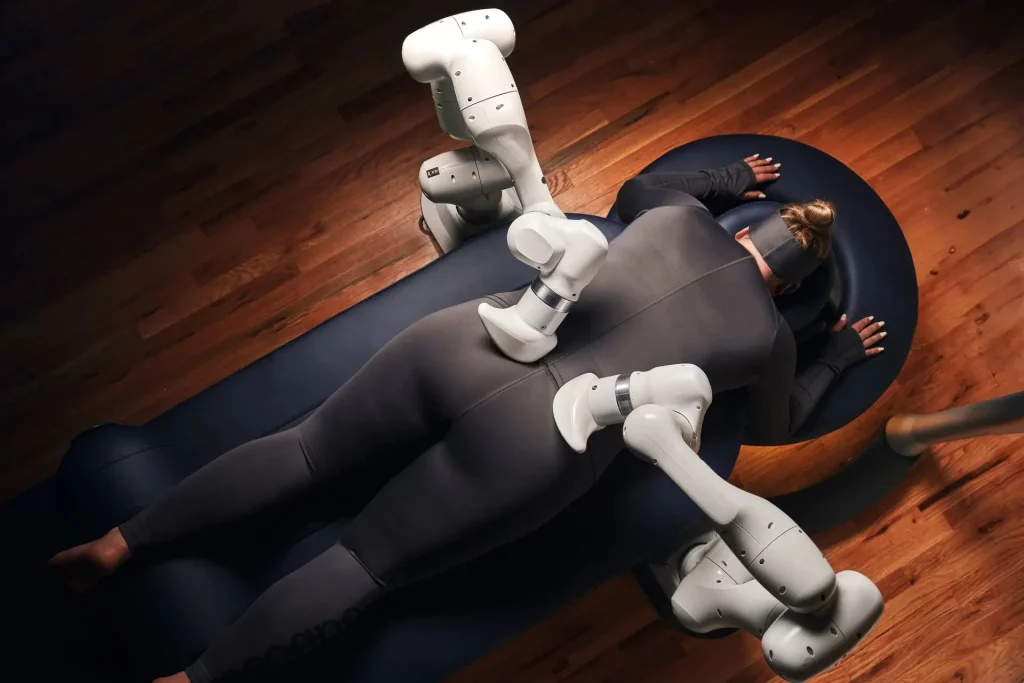
Its core product was a robotic massage table. The system could identify and analyze a user’s body through sensors, AI algorithms, and automated mechanical structures, then execute pre-set massage movements. Compared to traditional human massage, Aescape aimed to provide a more standardized, data-driven recovery experience while reducing long-term labor costs.
In recent years, the “Recovery Economy” has continued to gain momentum in the United States. Whether fitness enthusiasts, professional athletes, or high-end wellness consumers, there is a growing emphasis on post-exercise recovery, physical management, and health optimization. This trend also attracted substantial capital into recovery equipment, smart rehabilitation, and AI health fields.
Aescape gained market attention during this phase.
The company had partnered with various wellness and recovery settings and was seen as a representative case of “wellness automation.” Its concept aligned not only with the capital market’s preference for AI and robotics technology at the time but also with the U.S. wellness industry’s expectation for “standardized services” and “tech-enhanced experiences.”
However, moving from a technological concept to true commercial operation, Aescape soon faced real-world pressures.
According to bankruptcy filings, although the company gradually entered the commercial operation phase in 2024, its revenue scale remained limited. Meanwhile, its cash burn consistently stayed at a very high level. The robotic massage system itself is a highly complex electromechanical product, involving not only mechanical structures, force feedback, motor control, and sensor systems but also requiring continuous software development and AI algorithm investment.
For such a company, it is not merely a “hardware company” nor a pure software platform. Instead, it bears multiple costs simultaneously, including equipment R&D, AI system development, manufacturing, maintenance, and operational support.
This meant the company needed to sustain heavy spending over a long period before the market could truly mature.
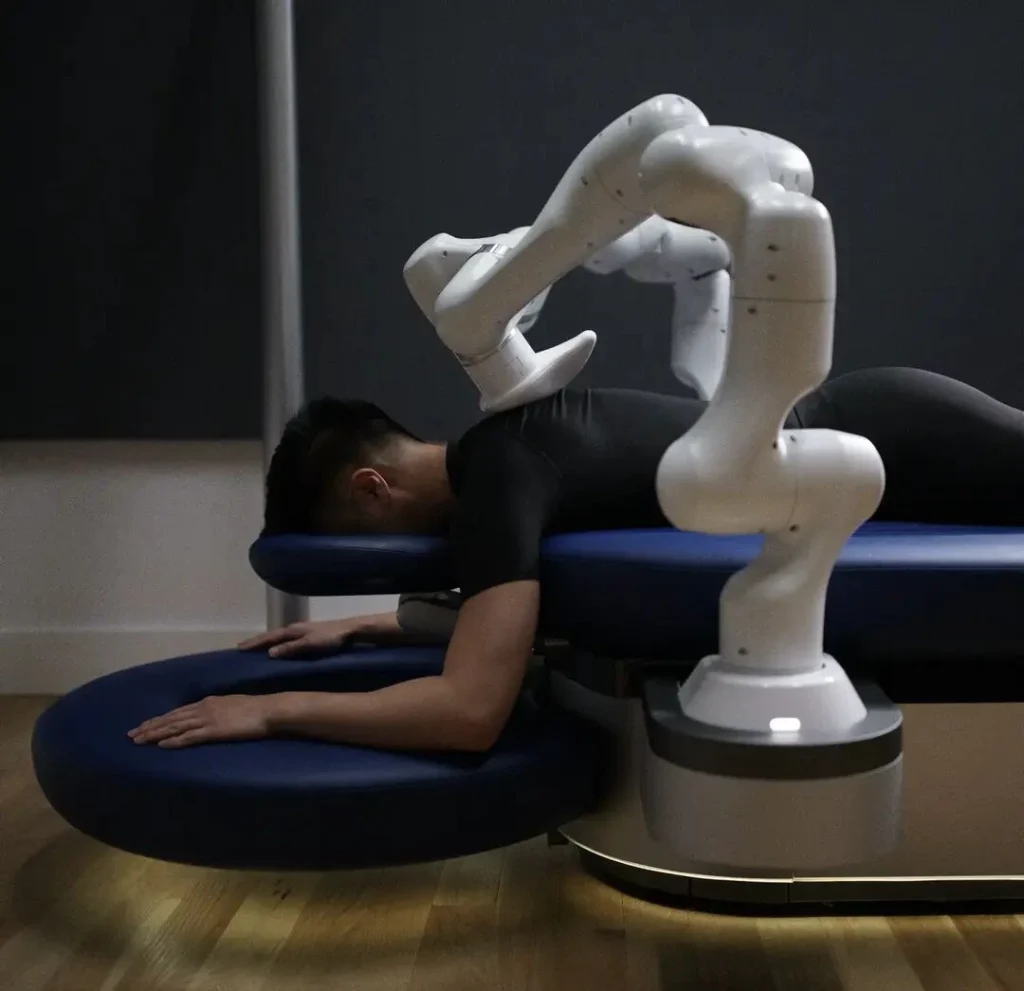
Source: Aescape
Collapse of the Funding Chain: The High-Capital Model Ultimately Spins Out of Control
Aescape’s financial problems fully erupted in late 2025.
Public records show that Silicon Valley Bank (SVB) formally issued a loan default notice to Aescape in December 2025. At that time, the company’s outstanding secured loan balance was at least 5 million revolving line of credit, hoping to help the company maintain short-term operations.
The problem, however, was that even with new financial support, Aescape failed to improve its cash flow situation.
For health tech companies heavily reliant on financing, once market expansion falls below expectations or the capital market environment shifts, the entire business model quickly comes under immense pressure. This is especially true for robotics companies, whose cost structures are often far higher than typical internet or SaaS companies.
The issues Aescape faced included both high R&D investment and market education costs.
While robotic massage generated buzz, practical operators still faced numerous real-world questions. For example, are consumers truly willing to accept robotic massage? Can the equipment genuinely replace human service? Is the equipment maintenance cost too high? Is the investment payback period reasonable? These questions impacted the product’s large-scale adoption.
Ultimately, the company failed to cure the loan default and entered public foreclosure auction proceedings in January 2026.
Notably, this auction had only one bidder: the later-formed Aescape Recovery Inc. This entity acquired nearly all of Aescape’s core assets via a $16.6 million “credit bid.”
Following the asset sale, the original Aescape Inc. essentially lost its ability to continue operations, becoming a shell company with almost no assets. Subsequently, the company’s directors formally initiated an assignment for the benefit of creditors (a type of bankruptcy proceeding).
As of now, the company still owes Black Stag approximately 152.6 million, which includes approximately $136.8 million in convertible notes.
Since the vast majority of assets were already sold off in the foreclosure, the likelihood of unsecured creditors receiving any meaningful payment in the future is extremely low.
Commercial Challenges in the Robotic Massage Sector Begin to Surface
The fall of Aescape does not mean robotic recovery technology itself has no future, but it does expose several core problems currently existing in this sector.
First, the wellness recovery industry itself is not as easily “automated” as many tech entrepreneurs initially envisioned.
Massage and recovery services involve more than just the execution of movements. The consumer experience also includes human interaction, trust, comfort, and emotional value. These aspects remain difficult for robots to genuinely replace.
Second, the business logic for robotic recovery equipment is far more complex than for ordinary consumer electronics.
The equipment is expensive, has high maintenance requirements, demands significant space, and has a relatively long update cycle. This means operators bear considerable upfront investment risk. In the current global capital environment, which is trending towards caution, the market’s patience for “high-investment, long-payback-period” projects is also waning.
More importantly, a key reason many AI health tech companies secured funding in recent years was their “future narrative” itself.
Keywords like AI, robotics, health management, and data-driven recovery were highly attractive to capital markets. But as the industry truly enters the commercialization phase, the market is starting to focus more on whether companies have real profit potential and if the unit economics are viable.
From this perspective, Aescape’s problem is not unique to the company but a reality facing the entire “AI + Health Hardware” industry.
Moving from Capital-Driven to Commercially Rational
The Aescape incident also reflects that the health technology industry is entering a new phase.
In recent years, market focus on AI and robotics concepts largely fueled the emergence of many highly-valued health tech companies. However, as the capital environment changes, the industry is gradually shifting from being “tech-story driven” to “commercial-results driven.”
In the future, robotic recovery and automated wellness equipment may still develop, but the industry’s path will likely become more pragmatic.
Rather than completely replacing human services, more companies may shift towards “assistive” solutions. For example, robots could handle some standardized recovery movements, combined with human service providers for a complete experience. Alternatively, AI recovery devices could be applied to specific scenarios like hotels, airports, or corporate wellness spaces, rather than directly challenging the traditional massage industry.
Simultaneously, the industry will pay more attention to equipment cost control, operational efficiency, and actual profitability, not just the technological concept itself.
It is worth noting that Aescape founder Eric Litman left the company in early 2026 and founded a new startup, Healthspanners, in March. This is not uncommon in the tech startup world: the original company fails, assets are restructured, and the founding team moves on to the next venture cycle.
For the entire industry, however, the real value Aescape leaves behind may not be its ultimate success, but that it exposed the real challenges in this sector ahead of time.
Conclusion: The Health Technology Industry Begins to Return to Reality
The bankruptcy of Aescape Inc. is more than an ordinary startup failure.
It resembles a typical “reality check” for the health technology industry after years of capital frenzy.
In the past, the market was accustomed to believing that as long as the technology was advanced enough, the AI smart enough, and the robots automated enough, they could rapidly transform the traditional wellness services industry. But reality has shown that the business logic of the wellness industry is far more complex than that of the internet industry.
User experience, service trust, operational costs, equipment maintenance, cash flow structure, and market acceptance all determine whether a company can ultimately survive.
For the entire fitness, rehabilitation, and health technology industry, the Aescape incident may also serve as a reminder: technological innovation is important, but what truly determines a company’s long-term viability is the balance between its business model, capital structure, and genuine market demand.




You must be logged in to post a comment.