
1. Core Export Data: Weihai Leads as China’s Watersports Gear Hits New Highs
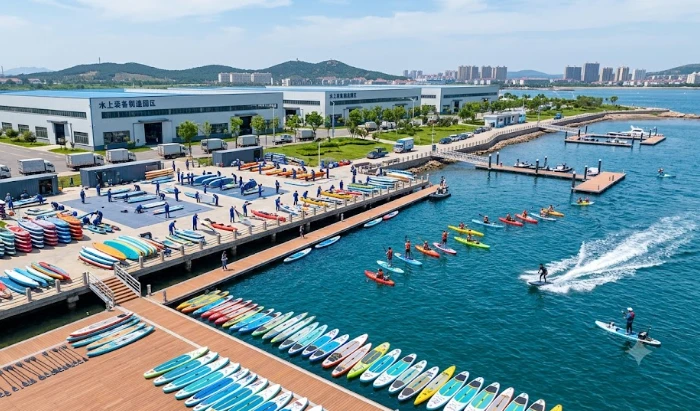
Since the onset of summer 2026, global enthusiasm for watersports has reached unprecedented levels, triggering an explosive growth phase for Chinese watersports equipment manufacturers. Key industrial hubs—led by Weihai (Shandong), Shenzhen (Guangdong), Wan’an (Jiangxi), and Ningbo (Zhejiang)—have seen overseas orders skyrocket, pushing both shipment volumes and total export value to historic peaks.
As the undisputed industry frontrunner, Weihai delivered an exceptional performance in the first half of 2026:
Overall Performance of Weihai City: In H1 2026, Weihai’s exports of watersports products reached 1.1 billion RMB (approx. USD $163 million), representing a 20.1% year-on-year (YoY) increase. Stand-up paddleboards (SUPs) and surfboards were the primary drivers, accounting for nearly 70% of total watersports exports and growing at a staggering 39.7% YoY.
Period Breakdown: Over the first five months of 2026, Weihai’s watersports gear exports totaled 950 million RMB (approx. USD $141 million), up 20.4% YoY, with SUP and surfboard exports expanding by 38.6%. Today, one out of every two paddleboards sold globally originates from Weihai.
Leading Enterprise Representation: Local industry player Hetong Sports shipped over 90,000 sets in H1 2026—a 1.5-fold increase YoY—and has successfully rolled out 12 proprietary product series under its own brand.
Beyond Weihai, watersports equipment manufacturing hubs across China are experiencing a boom:
Shenzhen, Guangdong: Enterprises specializing in motorized jetboards (power surfboards) reported overseas order growth of 30% to 40%, with factory production schedules booked out over two weeks in advance.
Wan’an, Jiangxi: Jiangxi Rentong Swimming & Diving Equipment recorded an export value of 2.73 million RMB (approx. USD $404,400) in the first five months, surging 64.8% YoY.
Ningbo, Zhejiang: Local boat paddle and oar manufacturers saw sales volume jump by 20%. By 2025, foreign trade exports from local watersports equipment makers had already approached 100 million RMB (approx. USD $14.81 million).
From a National Macro Perspective:
- H1 2026 National Figures: China’s total exports of sporting goods and equipment reached 67.53 billion RMB (approx. USD $10.00 billion). Of this, watersports equipment—including stand-up paddleboards—accounted for 4.77 billion RMB (approx. USD $707 million).
- Global Standing: China currently accounts for over 40% of global sporting goods exports, solidifying its status as the world’s top exporter. Growth rates to key overseas markets like the United States and Russia both exceeded 40% YoY, signaling exceptionally strong demand.
2. Industrial Cluster Transformation: End-to-End Efficiency & Cross-Industry Entrants
The rapid breakthrough of Chinese watersports equipment in global markets stems from a fundamental iteration and upgrading of the country’s industrial supply chain. While domestic firms previously acted primarily as OEM processing contractors, they are now accelerating their transition toward original brand manufacturing (OBM), leveraging unrivaled supply chain synergy and responsiveness.
Ultra-Fast R&D: “Full Material Sourcing Within a Few Dozen Kilometers”
Weihai has established a complete end-to-end industrial ecosystem encompassing raw material R&D, mold design, final assembly manufacturing, and cross-border e-commerce sales. All production materials can be sourced within a radius of a few dozen kilometers, enabling a new product to go from design drawing to a functional prototype ready for water testing in just a few days. In 2026, the region’s overall production capacity expanded 3 to 4 times year-on-year.
Dominance in Cross-Border E-Commerce Channels
Enterprises have largely executed the strategic transition from OEM contract manufacturing to OBM brand ownership. Among the top 10 best-selling paddleboard stores on Amazon, eight are owned by Weihai-based companies.
Empowerment from Cross-Industry Entrants
Heli Yuan Carbon Fiber, traditionally focused on automotive components, strategically crossed over into the watersports sector to supply carbon fiber paddles and hydrofoils to paddleboard manufacturers. In 2026, its capacity expanded 3 to 4 times, with watersports-related business now generating 55% to 60% of its total carbon fiber sales revenue.
Differentiated Regional Clustering Strategies
Guangdong Cluster: Focuses on high-end, tech-intensive categories like motorized jetboards. In just 5 years, local manufacturers achieved full in-house R&D of core generators and batteries, expanding product reach to over 55 countries globally.
Weihai Cluster: Leverages a scale-driven, lightweight inflatable SUP ecosystem to firmly lock down the global mass-market and mid-to-high-end consumer segments.
3. Product Innovation & Iteration: Niche Scenario Alignment & Lightweight Upgrades
In addition to supply chain completeness, continuous product optimization is a vital growth engine. Whether through ultra-lightweight engineering or functional segmentation, Chinese gear precisely matches the evolving practical demands of international consumers:
Lightweight Engineering & Extreme Value Proposition
Cixi, Zhejiang: A local enterprise introduced a newly developed blow-molded kayak that achieves a 30% weight reduction compared to traditional models while lowering retail prices by approximately 30%. The company set a full-year 2026 sales target of 80,000 units, representing a projected 50% YoY growth.
Ningbo, Zhejiang: Carbon fiber paddles manufactured locally have been engineered down to around 10 kg (per shipment/batch tier configuration), allowing even casual users and female paddlers to lift and maneuver them effortlessly, significantly lowering the barrier to entry for watersports.
Scenario Segmentation & Localized Micro-Innovations
Yiwu Canopy Swim Rings: Yiwu merchants launched inflatable swim rings featuring built-in sunshade canopies, directly addressing UV protection concerns. Orders have spiked drastically due to strong consumer demand.
High-Premium Customized Fishing Craft: To comply with varying international recreational fishing regulations, manufacturers have introduced inflatable SUPs and boats featuring integrated measurement scales and widened deck dimensions. These premium angler-specific craft command retail prices exceeding USD $2,000 (approx. 13,500 RMB) per unit, yielding profit margins more than double those of standard recreational models.
4. Conclusion
The explosive global demand for Chinese watersports gear—including surfboards, SUPs, motorized jetboards, and specialized craft—in 2026 reflects a deep structural transformation of Chinese manufacturing: transitioning from low-end OEM contract work toward a high-efficiency, high-quality, full-value-chain, and brand-first ecosystem. Driven by full-capacity production and surge orders across regional hubs like Shandong and Guangdong, Chinese manufacturing has firmly established itself at the core leadership position of the global watersports equipment supply chain.

You must be logged in to post a comment.