Analyzing Professor Carl Rohde’s Blueprint and the Strategic “Ecosystem Niche” for the Manufacturing Supply Chain
Introduction: Why We Must Re-examine “Integrated Health Solutions”
In today’s global wellness market, buzzwords like “integrated health solutions” and “one-stop closed-loop health ecosystems” have become dominant narratives among industry experts and startup founders alike. As observers of the global fitness product market, we recognize a fundamental truth: these integrated solutions genuinely represent an irreversible direction for the future of the industry.
However, in the actual marketplace, this core concept frequently polarizes into two problematic extremes:
• Selective Blindness in the Supply Chain: The vast majority of traditional upstream manufacturers, feeling far removed from the end-consumer, tend to dismiss this trend as an abstract, distant concept that has little to do with their daily operations.
• Overhyped Narratives in the Venture Capital (VC) Ecosystem: Conversely, many startup teams aggressively over-package the concept in their pitch decks and product launch manifestos, spinning unrealistic blueprints that are detached from operational realities.
In reality, an integrated health solution should not be treated as a transient marketing gimmick. Instead, it serves as a critical “North Star metric” that demands deep, sustained research from all industry players. In a turbulent and shifting market, companies must look past short-term, fleeting hype—the passing trends—and instead align themselves with the long-term industry tailwinds and define their precise “ecosystem niche.”
Professor Rohde’s Vision: Fitness as a Core Pillar of Future Preventive Health Platforms
To better grasp this global shift, we can draw valuable insights from the latest work of international trend researcher Professor Carl C. Rohde. In his influential paper, El fitness se integrará en las futuras plataformas de salud preventiva (Fitness Will Be Integrated into Future Preventive Health Platforms), he maps out a clear evolutionary trajectory for the global wellness industry.
The Core Thesis:
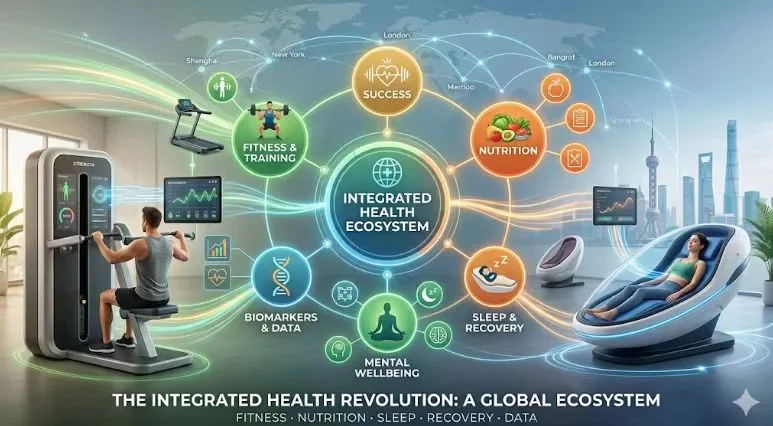
Future health will no longer be perceived as a collection of standalone products or isolated services. Instead, it will be understood as the systemic outcome of continuous, dynamic interactions between exercise, nutrition, sleep, recovery, mental well-being, and biomarkers.
1. From Functional Silos to a Unified Environment
Professor Rohde points out that for decades, the global health and wellness industry has operated in a highly fragmented state. Gyms focused exclusively on physical training, mobile apps tracked daily steps, doctors managed disease treatment, and nutritionists isolated dietary plans. Each domain operated like an information silo, largely disconnected from the others.
This fragmented model is undergoing a radical transformation. As consumers increasingly view health through a holistic lens, optimizing just a single variable—such as working out without addressing sleep or diet—is becoming highly inefficient. Consumers are demanding a comprehensive framework capable of coordinating their entire lifestyle. This demand is driving the rise of next-generation platforms that consolidate previously scattered tools into a single, unified environment.
Consequently, fitness is ceasing to exist as an independent vertical; it is evolving into a foundational pillar within a much broader, highly connected health ecosystem.
2. The “Jigsaw Puzzle” of Market Pioneers
A group of early market pioneers is already testing these waters across various sub-verticals, each acting as a distinct piece of a massive health puzzle:
• WHOOP
o Core Focus: Physical recovery, training load, and advanced sleep monitoring.
o Ecosystem Role: The foundational data stream.
• Oura
o Core Focus: Sleep architecture, physiological readiness, and diverse biomarkers.
o Ecosystem Role: The biometric wearable touchpoint.
• Zoe
o Core Focus: Highly personalized, data-driven nutrition tracking.
o Ecosystem Role: The behavioral intervention engine.
• Levels
o Core Focus: Metabolic health through real-time blood glucose monitoring.
o Ecosystem Role: The metabolic biomarker analyzer.
• Function Health
o Core Focus: Advanced, preventative medical diagnostics.
o Ecosystem Role: The entry gateway to preventive healthcare.
In Rohde’s view, the next strategic milestone will not be won by individual verticals, but by the super-platforms capable of seamlessly assembling these pieces to offer users a unified, 360-degree view of their health.
3. Redefining Core Corporate Assets
From a strategic standpoint, the most valuable position in this emerging ecosystem will not necessarily belong to the traditional brick-and-mortar gym, the physician, or a specific app. It will belong to the integrator platform that connects all elements. The entity that successfully assumes the role of the connector will control the core data, own the derivative insights, and command the highest-frequency daily interactions with the user.
In this new paradigm, traditional physical assets like treadmills or body composition analyzers are no longer the ultimate value drivers. The core asset has shifted to the continuous, data-driven relationship of daily companionship built with the user. Furthermore, the rise of Artificial Intelligence (AI), data-driven hyper-personalization, the structural shift of healthcare toward prevention, and the active involvement of employers and insurance providers (exemplified by the recent cross-industry partnership between LeFit and Ping An Insurance in China) will dramatically accelerate this ecosystem integration.
Beware the “Echo-Chamber Loop”: The Hidden Traps of All-Encompassing Business Plans
While the blueprint painted by Professor Rohde is compelling, rational market observers must remain highly vigilant.
In many startup circles, the concept of integrated health frequently devolves into a “closed-loop echo chamber.” Countless business plans map out overly ambitious roadmaps, claiming to build flawless, massive, all-encompassing ecosystems from day one. These models often carry significant underlying risks:
• Underestimating Cross-Disciplinary Barriers: Hardware companies that excel in a specific equipment vertical often severely underestimate the immense cross-industry resources, technological hurdles, and operational complexities required to integrate entirely different health modules.
• A Dangerous Lack of Empirical Validation: Many of these self-contained ecosystem models are built on a fragile foundation of subjective assumptions regarding user pain points and market demand, lacking rigorous, data-backed market research or real-world stress testing.
• An Industry Still in Its Infancy: It is critical to recognize that while integrated health platforms represent the definitive future, the global industry is still very much in an experimental phase. There is a long, arduous road ahead before these models mature.
• Deep Regional and Regulatory Fractures: Consumer habits, cultural backgrounds, digital infrastructure, and healthcare regulations vary drastically across different countries and regions. A successful business model cannot be copy-pasted globally; it must be tailored to local market realities. For small and medium-sized enterprises (SMEs) with finite resources, blindly chasing a massive platform play can become a fatal financial trap.
Capitalizing on Momentum: How Manufacturing Enterprises Find Their “Ecosystem Niche”
Given that building a massive, all-encompassing platform is unrealistic for the vast majority of fitness equipment manufacturers, should these companies simply ignore this macroeconomic shift? Absolutely not. On the contrary, product R&D and business strategies must remain deeply synchronized with these global trends.
In this sweeping industry restructuring driven by the integration of exercise, nutrition, sleep, and biomarkers, the strategic imperative for hardware manufacturers—especially those operating within OEM and ODM frameworks—is clear: Your goal is not to build the entire ecosystem yourself. Your goal is to figure out how to become an indispensable, high-value link within the broader global value chain.
The success of hardware-heavy pioneers like WHOOP and Oura demonstrates that even the most complex ecosystems are built on top of premium, precise components. Manufacturers must re-evaluate their existing assets through a forward-looking lens:
• Ecosystem Integration Capabilities: Are our current treadmills, strength equipment, or recovery devices equipped with the open APIs and connectivity features required to integrate seamlessly into mainstream preventive health platforms?
• Proactive Functional Value: Can we proactively engineer data-acquisition interfaces, advanced biometric monitoring sensors, or cutting-edge scientific recovery technologies directly into our existing hardware lines?
By leveraging existing manufacturing strengths and upgrading products along a structured path of digitization, intellectualization, and enhanced functionality, companies can naturally imbed themselves into the new health value chain. This allows businesses to execute a vital strategic pivot: transforming from a pure-play traditional OEM manufacturer into a high-value, “core hardware provider” within the global health ecosystem.
Conclusion: Lifting Our Gaze—The Path to Sustainable Growth for Global Fitness Brands
The global fitness equipment manufacturing sector is currently navigating a critical transition, moving rapidly from low-cost, volume-driven manufacturing toward high-value, global brand equity. While it remains vital to maintain operational excellence and optimize production costs, it is equally important for leadership teams to regularly lift their gaze to scan the horizon and align with global health market shifts.
Studying long-term market trends is not about chasing volatile, short-term hype or engaging in reckless capital expenditure that overextends company resources. It is about accurately reading the fundamental direction of the industry’s evolution. In an interconnected and fast-moving global marketplace, enterprises must avoid two critical mistakes: they cannot afford to chase hollow, over-engineered “closed-loop” illusions, nor can they afford to complacently stagnate in the shrinking margins of the traditional OEM comfort zone.
By recognizing the inevitable rise of integrated preventive health platforms, manufacturing enterprises can anchor themselves securely within the global value chain. Armed with deep manufacturing expertise, pragmatic functional innovation, and an agile approach to technological integration, global fitness brands will successfully navigate the waves of globalization and secure a path of sustainable, long-term market growth.