

In recent years, as the global sporting goods and fitness equipment market continues to expand, intellectual property (IP) has evolved from a peripheral compliance issue into a central factor in industry competition. Trademark squatting, design patent imitation, and unauthorized brand usage are no longer isolated incidents—they are recurring challenges across both domestic and international markets, increasingly leading to cross-border disputes.
Based on a systematic review of 9,953 IP-related civil cases (2021–2026) in the sporting goods sector—conducted by the China Sporting Goods Federation using the Peking University Law Database, with 600 key cases analyzed in depth—clear patterns are emerging that deserve the attention of global industry stakeholders.
Case Structure: Trademark Dominance, but Patent Risks Are More Critical
Among all cases, disputes related to IP ownership and infringement account for 93.78%, forming the overwhelming majority of legal conflicts in the sector.
Breaking this down further:
- Trademark disputes: 6,237 cases (62.66%)
- Copyright disputes: 1,810 cases (18.19%)
- Patent disputes: 1,217 cases (12.23%)
While trademark infringement remains the most common issue—primarily involving brand misuse and market confusion—the deeper insight lies in the 600 key cases, where patent disputes account for 47.0%.
This contrast highlights an important industry reality:
Although fewer in number, patent disputes are more technically complex, more contentious, and often carry significantly higher commercial and financial risks.
Design Patents: The Primary Risk Area in Fitness Equipment
Within the 282 patent-related cases analyzed, design patents account for 78.0% (220 cases), while invention patents represent only 9.6%.
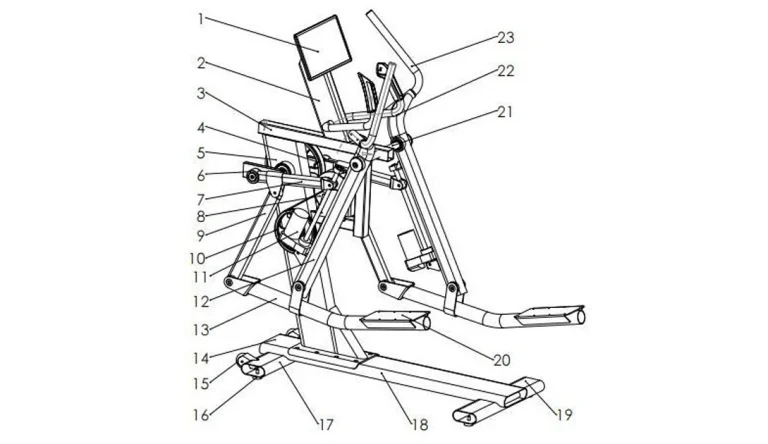
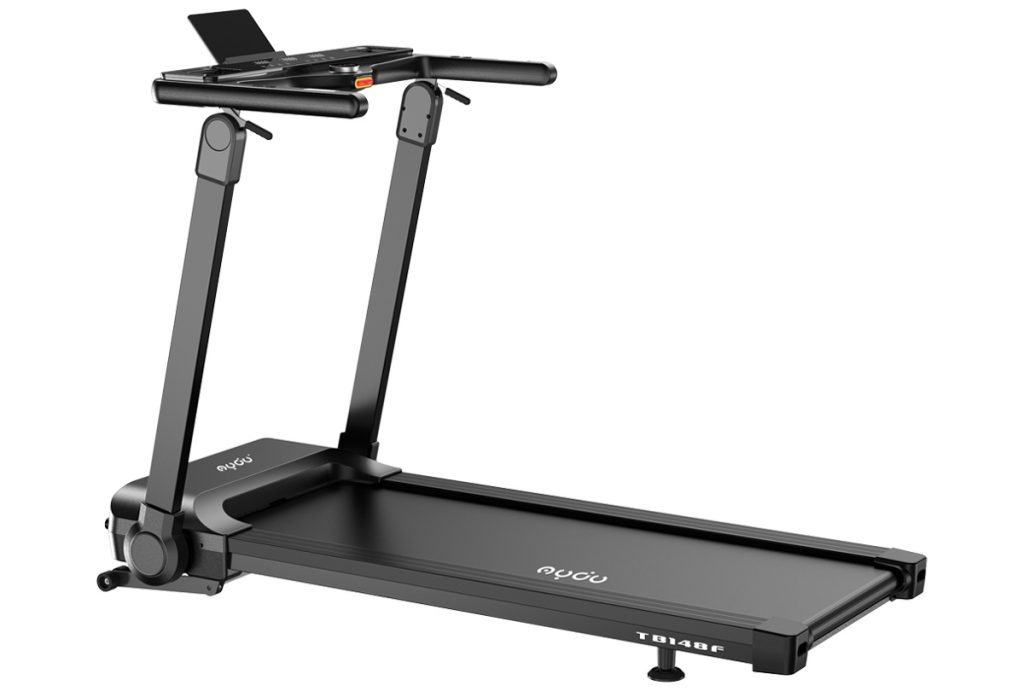
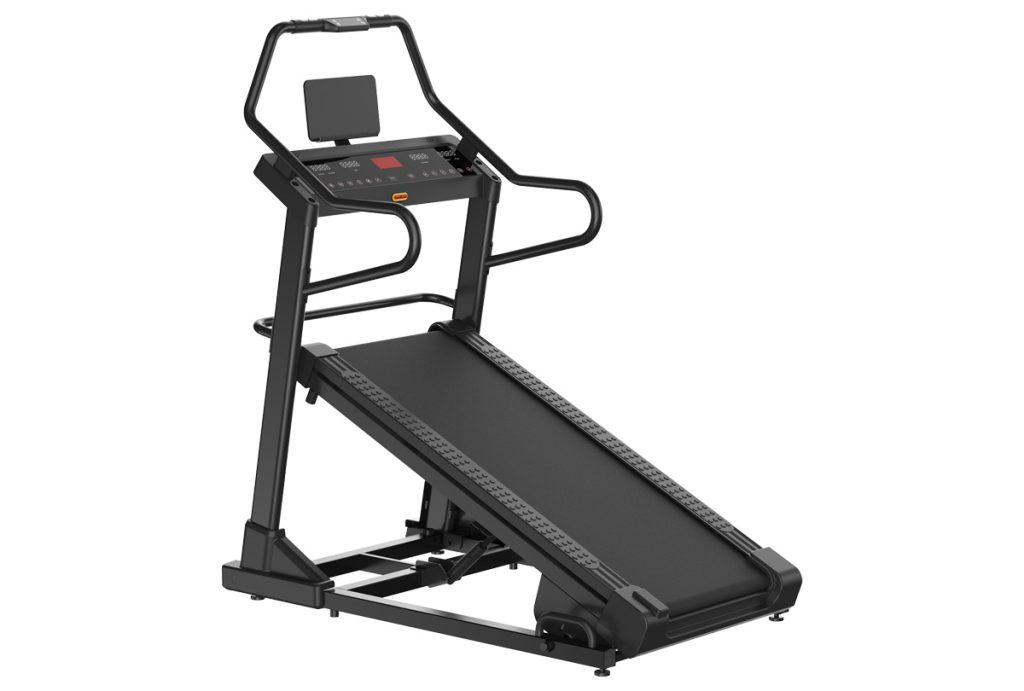
This distribution reflects the nature of the fitness equipment industry. Products such as treadmills, ellipticals, massage guns, and recovery devices compete heavily on visual design and user perception, making overall appearance a critical differentiator.
As a result, “overall visual similarity” becomes the key criterion in determining infringement.
From a practical standpoint, many manufacturers still rely on “benchmarking” or closely referencing existing international products during development. While this may offer short-term efficiency, it significantly increases the risk of infringement—especially when entering regulated markets such as the EU and the United States.
Trends and Geography: Fewer Cases, but Not Lower Risk
Looking at the annual data:
| Year | Number of Cases |
| 2021 | 2,448 |
| 2022 | 2,347 |
| 2023 | 2,253 |
| 2024 | 1,702 |
| 2025 | 1,469 |
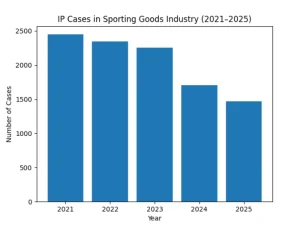
The total number of cases has declined by approximately 40% over five years, suggesting improvements in IP awareness and regulatory enforcement.
However, this decline should not be misinterpreted as a reduction in infringement activity. In practice, risks are increasingly shifting upstream into product development and supply chains, or becoming less visible due to more cautious behavior.
Geographically, cases are highly concentrated in key manufacturing regions:
- Guangdong: 1,765 cases (17.73%)
- Shanghai: 1,599 cases (16.06%)
- Zhejiang: 938 cases (9.42%)
- Fujian: 723 cases (7.26%)
By region:
- East China: 42.69%
- South China: 21.93%
- Central China: 8.75%
Together, these regions account for 73.37% of all cases, closely aligning with China’s major sporting goods manufacturing clusters such as the Pearl River Delta, Jinjiang, and Ningbo.
This indicates a clear structural pattern:
IP disputes tend to emerge where production scale and product similarity are highest.
Root Causes and Strategic Implications for Global Trade
The recurring nature of IP disputes in China’s sporting goods sector is closely linked to its historical development model. For decades, the industry has been driven by OEM and ODM manufacturing, where efficiency, cost control, and speed to market were prioritized over originality and IP strategy.
As product categories matured and competition intensified, many companies adopted “fast-follow” approaches—leveraging existing designs to shorten development cycles. While this was once commercially viable, it is increasingly incompatible with today’s global trade environment.
IP is no longer just a legal safeguard—it is a market access requirement and a core component of brand value.
For companies engaged in international trade, this shift has several important implications:
First, Risk management must start from thebeginning
IP risk management must be integrated into the early stages of product development. Design validation, patent searches, and differentiation strategies should be conducted before finalizing products—not after.
Second, Develop your own design language
companies should avoid designing products based on a single reference brand. Instead, they should aim for independent design language, combining structural and visual differentiation to reduce infringement risk.
Third, Protect your intellectual property rights
proactive IP protection is essential. This includes:
- Filing design patents in key markets
- Registering trademarks internationally
- Maintaining clear documentation of design and development processes
Finally, Risks of imitation
a critical issue remains: some Chinese exporters continue to replicate or closely imitate well-known international brands. In global markets, such practices can lead to:
- Customs seizures
- E-commerce platform bans
- Legal claims and financial penalties
More importantly, they undermine the long-term credibility of Chinese manufacturing as a whole.
Conclusion: IP as a Strategic Lever for Industry Upgrade
China’s sporting goods and fitness equipment industry is currently transitioning from OEM-driven production toward brand building and innovation-led growth. In this process, intellectual property is no longer a secondary consideration—it is a defining factor in competitive positioning.
Moving from “copy manufacturing” to “original innovation” is not only a technological evolution, but also a strategic necessity. Companies that invest in design, protect their IP, and operate within global legal frameworks will be better positioned to build trust, capture value, and compete internationally.