
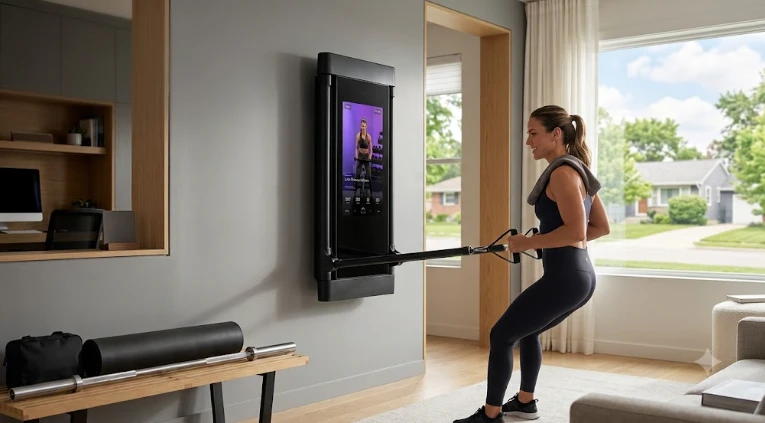
Smart fitness equipment giant Tonal has announced the launch of “Tonal Rent,” a monthly rental option allowing consumers to access its smart strength machines for a recurring fee instead of paying a steep upfront purchase price. This marks the first time the brand has offered a hardware rental program since its debut in 2015, as well as the first major strategic initiative under new CEO Todd Bartee, who took the helm in February.
At a Glance: Key Details of the Tonal Rent Program
Powered and operated by third-party rental platform Whim, Tonal Rent is available to residents aged 18 and older in the contiguous U.S. (excluding Hawaii and Alaska):
Tiered Pricing:
- Brand-New Tonal 2: $279/month
- Certified Refurbished Tonal 1: $219/month
All-Inclusive Package:
The monthly fee bundles the machine itself, a complete accessories kit (including smart handles, smart bar, and other training gear), full digital membership access, and complimentary white-glove delivery and professional installation.
Promotional Offer & Flexibility:
Renters who sign up before August 17 receive their first month free, with standard monthly rates applying thereafter. The program features no long-term commitment—members can cancel at any time (Tonal will pick up returned units free of charge) or request a purchase quote to buy the machine outright.
Maintenance & Replacement Coverage:
As long as rental payments remain current, Tonal will replace equipment free of charge for any issues arising from normal wear and tear.
To put this into context, purchasing a Tonal unit outright carries a significant financial barrier: full retail price stands at $2,495 for the Tonal 1 and $4,295 for the Tonal 2.
Tonal has also pursued other avenues to broaden its appeal recently, including a try-before-you-buy retail partnership with Johnson Fitness & Wellness across more than 100 U.S. locations, as well as onboarding celebrity instructor Kristin McGee to lead a Pilates-inspired program. By launching Tonal Rent with zero upfront costs, the company aims to eliminate entry friction, drive conversion rates, and boost membership retention.
Industry Observation: A Defensive Compromise Facing Heavy Competition
Following the hyper-growth phase during the pandemic, the connected fitness sector has broadly encountered a growth bottleneck characterized by “high purchase thresholds and low subscription renewal willingness.” Tonal’s shift toward a rental model may look like a proactive move to expand its addressable market, but under the surface, it reflects a necessary compromise in response to intensifying market pressures.
1. Looming Price Wars and High Total Cost of Ownership (TCO)
Competitors like Speediance are entering the space with significantly more cost-effective hardware strategies. Although Tonal attempts to lower the entry point to roughly $200–$300 a month via rentals, the Total Cost of Ownership (TCO) for consumers remains exceptionally high:
Wall-Mounting Constraints: Tonal’s design requires wall installation, placing strict demands on home wall types (stud placement, load-bearing requirements, and permanent wall damage). For renters or users hesitant to drill into walls, installation friction and psychological barriers remain steep.
Mandatory High Subscription Fees: Tonal’s business model relies heavily on a premium monthly subscription. In contrast, competitors like Speediance offer more affordable hardware alongside free or low-cost subscription options, significantly undermining Tonal’s long-term value proposition.
2. Supply Chain Advantages and Rapid Iteration from Emerging Brands
The technological moat around smart strength equipment is narrowing rapidly. As a wave of similar products enters the U.S. market—particularly from Asian brands leveraging mature, cost-efficient supply chains and rapid R&D iteration cycles—legacy American unicorns like Tonal are facing unprecedented pressure.
The days of relying solely on high price points and brand premium are giving way to a multi-dimensional battle encompassing supply chain cost management, software ecosystem experience, and customer acquisition costs (CAC).
3. Looking Ahead: Can Tonal Avoid the “Peloton Trap”?
Peloton introduced a similar bike rental model back in 2022. While it temporarily boosted subscriber numbers, it also burdened the company with heavy balance-sheet liabilities, asset depreciation, and rising logistics costs for returns and refurbishments.
Whether new CEO Todd Bartee can navigate Tonal toward sustainable profitability through this rental model—and defend its premium positioning against high-value competitors—remains a key test for the brand moving forward.