

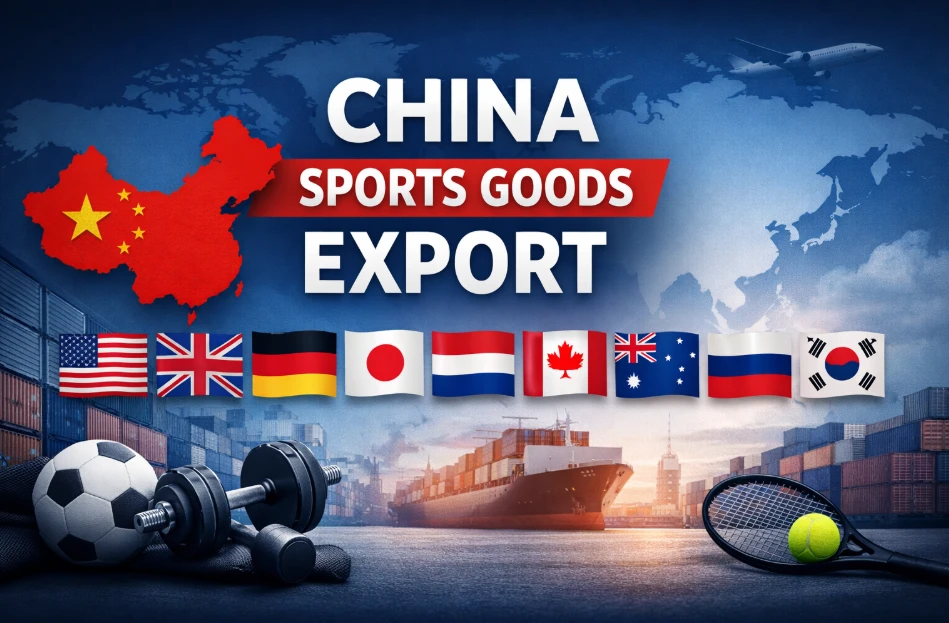
In 2025, China’s sports goods export sector demonstrated a pattern of “overall stability with structural changes.” Against the backdrop of a complex global trade environment, ongoing regional demand divergence, and supply chain adjustments, total export volume maintained slight growth. However, significant differences emerged across markets and product categories.
From a data perspective, the year did not show dramatic fluctuations. Yet structurally, the global demand and supply system for sports goods is undergoing a deeper transformation.
Overall Export Performance: Stable Volume with Emerging Structural Shifts
According to customs data, China’s total sports goods exports in 2025 increased by 0.96% year-on-year, continuing the trend of modest growth seen in recent years. While the overall scale remains stable, growth momentum has clearly slowed.
Monthly data shows increased volatility. In December, exports declined by 4.42% year-on-year but increased by 9.14% compared to the previous month. This reflects a combination of order cycle adjustments and short-term demand recovery.
In terms of market structure, China’s sports goods exports remain relatively concentrated. The top ten export destinations in 2025 were:
The United States, the United Kingdom, Germany, Japan, the Netherlands, Canada, Australia, Russia, France, and South Korea.
These ten markets together accounted for approximately 57% of total exports, but declined by 2.96% year-on-year. This indicates that while traditional core markets still dominate, their growth has weakened, and demand is gradually shifting toward a broader range of regions.
North America: Significant Pressure Under Tariff Impact
North America showed a notable decline in 2025, becoming a key drag on overall export performance.
China’s exports to North America fell by 9.86% year-on-year, accounting for about 32% of total exports, down 4 percentage points from the previous year. Within this, exports to the United States declined by 11.57%, representing roughly 30% of total exports.
This trend is closely linked to the continued impact of U.S. tariff policies. Rising costs and increased uncertainty have led to order shifts and prompted adjustments in supply chain strategies.
From a product perspective, the North American market shows clear divergence. On one hand, fitness and rehabilitation-related products maintained growth. “Other fitness and rehabilitation equipment” increased by 6.42%, while niche outdoor products such as fishing rods and hooks also recorded moderate growth.
On the other hand, traditional sports goods declined significantly. General sports equipment exports fell by 11%, treadmill exports dropped sharply by 37.34%, ball sports (football, basketball, volleyball) declined by 23.8%, and golf-related products decreased by as much as 54.57%.
Overall, North America is transitioning away from the pandemic-driven home fitness boom, while traditional sports consumption is being constrained by broader economic conditions.
Europe: Recovery and Structural Upgrade Driving Growth
In contrast to North America, Europe showed strong recovery in 2025 and became a key growth engine.
China’s exports to Europe increased by 14.54% year-on-year, accounting for approximately 28% of total exports, up 4 percentage points from the previous year.
The European market displays a dual-layer growth structure. Western Europe is experiencing demand recovery, with countries such as the UK, Germany, the Netherlands, France, and Spain all achieving double-digit growth. Meanwhile, Central and Eastern Europe is expanding more rapidly, with countries like Greece, the Czech Republic, Hungary, and Austria recording growth rates between 30% and 50%.
From a product standpoint, demand in Europe is increasingly focused on health and wellness. Treadmills and fitness/rehabilitation equipment grew by over 30%, while racket sports (badminton, tennis) and certain outdoor-related products saw growth exceeding 40%.
This indicates that Europe is not only recovering in volume but also upgrading its consumption structure, with increasing emphasis on health management, home fitness, and lightweight sports activities.
Emerging Markets: Divergence with New Growth Potential
Beyond traditional markets, emerging markets continued to play a critical role in 2025 and are increasingly becoming key drivers of export growth.
Exports to countries along the Belt and Road Initiative grew by 4.14% year-on-year, maintaining steady overall growth. However, performance varied significantly across regions.
Markets such as Russia, South Korea, and Thailand remained relatively stable, while Vietnam, Indonesia, and Kazakhstan showed strong growth. In contrast, some Southeast Asian countries—including Malaysia, the Philippines, and Singapore—experienced notable declines, reflecting shifts in re-export trade and regional supply chain adjustments.
At the same time, several emerging markets demonstrated strong growth momentum. Countries such as Turkey, Kyrgyzstan, Greece, and Peru achieved growth rates between 30% and 50%, indicating a rapid expansion of demand across Central and Eastern Europe, Central Asia, and Latin America.
Among these, Latin America stands out as a key growth region. China’s exports to the region increased by 15.41% year-on-year. Brazil remained the primary driver of growth, while Mexico experienced some decline, slightly offsetting regional performance. Meanwhile, Chile and Colombia maintained stable growth.
Several markets showed particularly strong performance. Argentina recorded triple-digit growth, while Uruguay, Ecuador, Paraguay, and Nicaragua all achieved growth rates between 30% and 50%, highlighting the rapid expansion of demand in these emerging economies.
From a product perspective, emerging markets show strong demand for diversified and recreational products. Treadmills, sports balls, water sports equipment (such as surfboards and water skis), and racket products all recorded growth rates between 90% and 200%, becoming key drivers of export expansion.
Key Takeaways: A Reshaping Global Market
The 2025 data clearly indicates that China’s sports goods export sector is undergoing a structural transition.
First, the global market is shifting from concentration to diversification. The share of the U.S. market is declining, while Europe, Central and Eastern Europe, and Latin America are gaining importance.
Second, policy factors are playing an increasingly direct role in shaping trade flows. Tariffs, regulatory changes, and supply chain restructuring are becoming critical variables.
Third, product demand is evolving. Traditional sports goods are under pressure, while fitness, rehabilitation, and outdoor-related products continue to grow, reflecting a shift from competitive sports to health and lifestyle-oriented consumption.
Finally, emerging markets are becoming increasingly important. Regions such as Latin America, Central and Eastern Europe, and Central Asia are transitioning from secondary markets to key growth drivers.
Conclusion
The performance of China’s sports goods exports in 2025 reflects more than just incremental changes in trade volume. Beneath the stable headline figures lies a profound structural transformation of the global market.
For industry players, future success will no longer depend solely on scale or cost advantages. Instead, it will require stronger capabilities in multi-market strategy, product adaptation, and supply chain coordination.
In this sense, 2025 should be seen not as a year of fluctuation, but as a turning point signaling the next phase of global restructuring in the sports goods industry.




You must be logged in to post a comment.