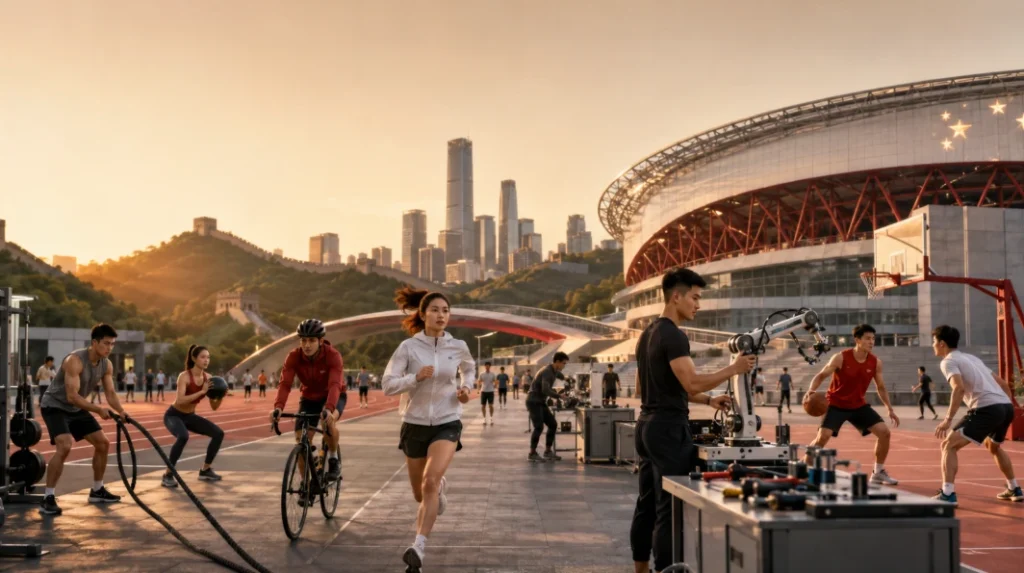
China’s General Administration of Sport has officially released the “15th Five-Year Plan” for Building a Sports Powerhouse. Marking the first time sports development has been elevated into China’s top-tier national-level special planning framework, the blueprint outlines key targets through 2030—most notably projecting the country’s total sports industry market size to cross RMB 7 trillion (approx. USD 970+ billion).
Key 2030 Performance Indicators: Paving the Way for Market Expansion
As China prepares to solidify its foundational transition toward modern economic development over the “15th Five-Year Plan” period, the sports sector is set to undergo rapid acceleration and quality upgrading. Based on comprehensive regional research and public feedback, the policy establishes five key metrics targeted for 2030:
- Sports Industry Output: Total market scale to surpass RMB 7 trillion.
- Per Capita Sports Venue Area: Reaching approximately 4 square meters per person.
- Fitness Participation Rate: Regular physical exercise rate reaching roughly 40% of the population.
- National Health Standards: Excellent/Good physical fitness rate hitting 31.1%.
- Competitive Athletics: Sustaining top-tier international standings in world championship titles.
Strategic Focus Areas: Infrastructure, Youth Talent, and Gear Opportunities
The framework outlines 38 priority tasks and 8 dedicated infrastructure initiatives spanning the entire sports and fitness value chain:
1. Public Fitness & Venue Infrastructure Expansion
The plan launches an expansion program for public athletic spaces, encouraging local governments to utilize underutilized urban real estate (“corners and margins”). Upgrades will focus on accessibility, age-friendly modifications, and youth-oriented facilities, alongside deeper integration between sports science and public health.
2. K-12 Talent Pipelines & Youth Wellness
A streamlined talent cultivation pathway spanning elementary through high school will be established specifically for the “Big Three” ball sports (soccer, basketball, volleyball). Concurrently, targeted health initiatives will address youth issues such as myopia, obesity, scoliosis, and mental health.
3. Modernizing the Sports Economy & Commercial Sectors
To boost domestic consumption, China will accelerate the development of event-driven economies, expand on the winter sports boom, and initiate upgrades across the outdoor gear and recreation sectors. New consumer verticals—such as senior fitness (“silver economy”) and family-oriented sports gear—are highlighted as key growth drivers.
4. Cultural Heritage & Global Reach
Efforts will be directed toward building national sports culture brands, fostering venue etiquette, and promoting traditional Chinese sports on the international stage.
Implementation & Oversight Mechanisms
To guarantee execution across regional and national sports administrations, the General Administration of Sport outlined a four-pillar accountability structure:
Governance & Leadership: Centralizing strategy across all local governmental levels with defined primary responsibilities.
Inter-Ministerial & Regional Coordination: Aligning local sports bureaus, governing bodies, and sports associations to match annual targets with long-term strategy.
Industry Alignment: Conducting nationwide educational and policy-breakdown campaigns to align sector stakeholders.
Dynamic Monitoring: Instituting mid-term and final performance evaluations to track progress and adjust execution strategies in real time.