
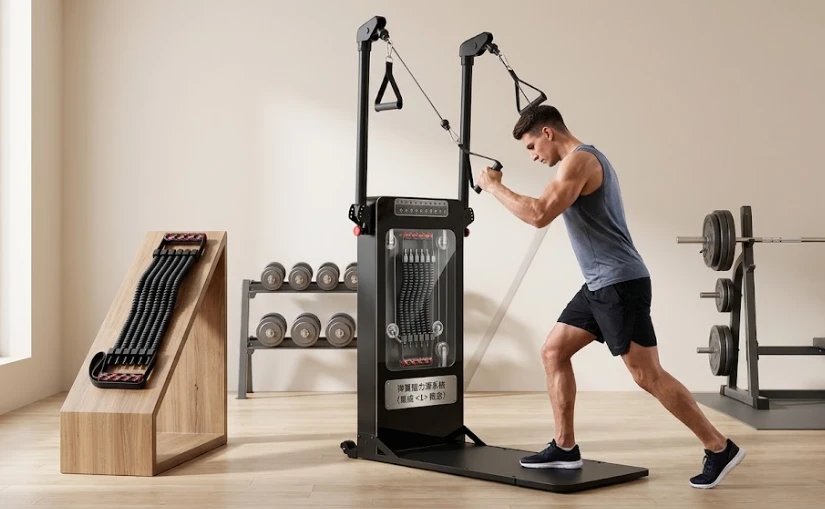
In today’s fitness equipment landscape, motorized digital resistance systems and smart home gyms are rapidly gaining market traction. However, behind the electronic interfaces lies a fundamental mechanical question: How do we optimize resistance generation to balance performance, cost, and user experience?
While traditional weight stacks, magnetic systems, air resistance, flywheels, and hydraulic actuators each possess distinct physical properties, mechanical engineering continues to unlock novel approaches.
A newly patented technological innovation—the Constant-Force Spring System—introduces a mechanical torque-compensated resistance scheme. Engineered as an alternative to both heavy passive loads and complex active drive systems, this technology redefines how elastic resistance can be applied in high-performance resistance training.
1. The Genesis of the Constant-Force Spring System
The Constant-Force Spring System for strength training was developed by Mr. Wei Chuanmin, founder and chief engineer of China-based ToFit Technology Co., Ltd.
After analyzing the physical limitations of existing resistance mechanisms on the market, Mr. Wei spent over three years developing and refining a mechanical architecture based on spring tension. This effort culminated in the commercialization of the Constant-Force Spring Strength Trainer (Patent Publication No.: CN120053934A).
Technical Distinction: “Constant-Force Spring” vs. “Constant-Force Spring System”
In mechanical engineering discussions, it is crucial to differentiate a standalone component from a complete mechanical system:
• Constant-Force Spring (The Component): A specialized spring fabricated from pre-stressed flat strip stock coiled around a spool (similar to a clockwork mainspring). Its constant tension property relies entirely on the material’s geometry and physical pre-wrap. However, its constant-force output is strictly limited to a specific “effective working stroke window.”
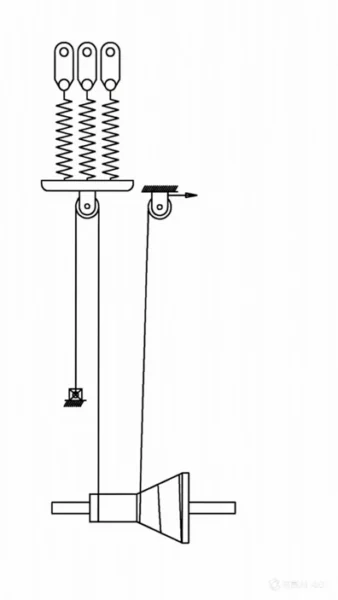
• Constant-Force Spring System (The System Architecture): A complete mechanical assembly. It utilizes standard industrial extension or compression springs paired with a specialized variable-radius cam (variable-diameter pulley) mechanism, steel cables, and guide pulleys. Through dynamic torque compensation, the system enables standard linear springs to deliver constant, non-linear resistance across an extended stroke range.
Key Engineering Insight: A constant-force spring achieves uniform load via specialized metallurgy; a constant-force spring system imparts uniform output to standard springs through mechanical leverage design.
2. Core Engineering Advantages of the System Architecture
Superior Fatigue Life and Low Maintenance Requirements
By utilizing standard industrial-grade tension or compression springs operating well within their elastic deformation limits, the core resistance elements achieve a fatigue life exceeding 10 million cycles. Because the assembly relies on purely mechanical linkage without electronic components or pneumatic seals, system degradation and maintenance overhead are minimized.
Full-Stroke Linear Resistance Output (Zero Curve Distortion)
Under Hooke’s Law ($F = k \cdot x$), a standard spring’s restoring force increases linearly with stretch distance ($x$), resulting in an undesirable “heavier at end-range” feeling during exercise.
The Constant-Force Spring System addresses this through a mathematically profiled variable-radius cam. As the cable is pulled and the spring stretches (increasing force $F$), the cable tracks along a smaller radius on the variable cam, shortening the moment arm ($r$).
Because Torque ($\tau$) = Spring Force ($F$) × Moment Arm ($r$), the increase in spring force is inversely proportional to the decrease in moment arm length. As a result, output torque and resistance at the handle remain constant throughout the entire stroke.
Cost Efficiency and Zero-Power Operation
Unlike servo-driven digital strength systems that require high-torque motors, microcontrollers, active cooling, and external AC power, the Constant-Force Spring System is entirely passive (unpowered). It also eliminates the need for pneumatic compressors and pressure lines. This yields a lower Bill of Materials (BOM) cost while preserving high performance, making it viable for both residential and commercial deployments.
3. Comparing Resistance Sources in Strength Equipment
To evaluate where this technology fits into the current market, here is how the Constant-Force Spring System compares against traditional and modern resistance sources:
Weight Stack / Plate-Loaded Systems
• Physics: Gravitational Force.
• Characteristics: High inertia with noticeable momentum at initiation and direction changes.
• Power & Maintenance: Purely mechanical with zero power needed. Low maintenance, but high shipping and structural frame costs.
• Primary Use: Hypertrophy and maximum strength training (Powerlifting, Bodybuilding).
Motor-Driven Servo Systems
• Physics: Electro-magnetic Torque Vector Control.
• Characteristics: Programmable with zero passive inertia; enables eccentric overload, isokinetic, and adaptive curves.
• Power & Maintenance: Requires AC power, motor drives, sensors, and thermal management. High initial cost and complex servicing.
• Primary Use: Premium digital home gyms, rehabilitation, and athletic testing.
Pneumatic (Air Cylinder) Systems
• Physics: Fluid Dynamics / Gas Compression.
• Characteristics: Very low inertia; smooth at high movement velocities with low joint impact.
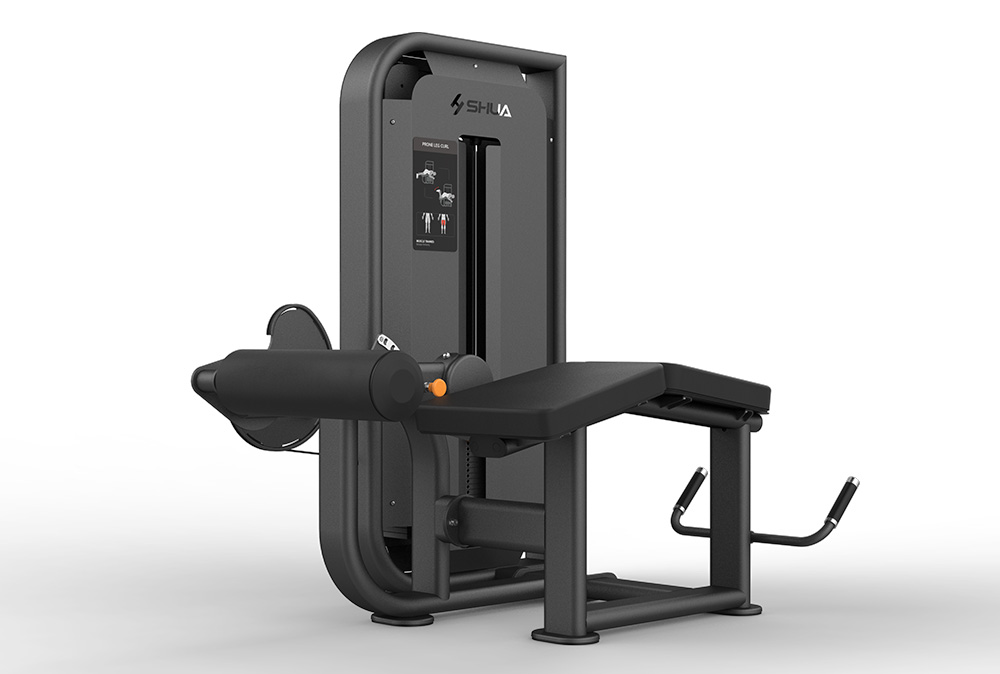
• Power & Maintenance: Requires an external air compressor, air lines, and valves. Susceptible to seal wear and system pressure leaks.
• Primary Use: Velocity-Based Training (VBT), athletic performance, and rehab.
Constant-Force Spring Systems
• Physics: Mechanical Torque Compensation.
• Characteristics: Low inertia with high dynamic response; uniform resistance profile regardless of acceleration.
• Power & Maintenance: Purely mechanical and zero power required. Low cost, high reliability, and minimal maintenance.
• Primary Use: Functional training, residential home gyms, unpowered outdoor setups, and commercial fitness centers.

4. Commercial Realization: The TOFitness T01 Functional Trainer
The first commercial application featuring this mechanical architecture is the TOFitness T01, a multi-functional trainer engineered for residential environments:
• Chassis Weight Reduction: The complete machine weighs 55 kg, representing a greater than 50% weight reduction compared to conventional selectorized weight-stack equipment of equivalent output capacity. The frame combines high-strength structural steel, acrylic accents, and wood finishes to fit modern living spaces.
• Granular Resistance Control: Features a push-button adjustment interface offering 20 discrete resistance increments, ranging from a minimum starting load of 1.25 kg up to a maximum output of 60 kg.
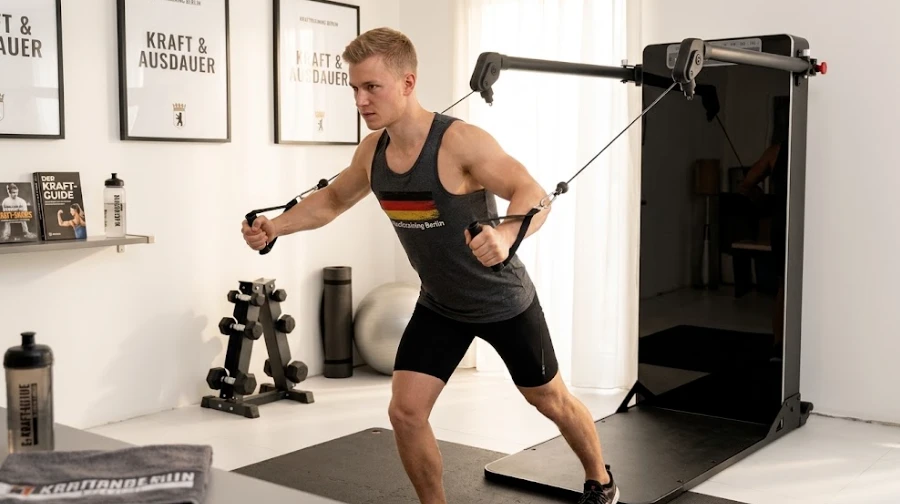
• Dual Multi-Axis Articulating Arms: Outfitted with dual adjustable arms featuring 9 horizontal positions and 4 vertical positions. This multi-axis cable alignment allows users to execute over 100 distinct functional movements covering upper-body, lower-body, and core isolation exercises.
Conclusion
As the fitness industry moves toward equipment that combines performance, safety, mobility, and energy efficiency, alternative mechanical resistance systems offer clear engineering advantages.
By unifying the low-inertia profiles of pneumatic systems with the unpowered simplicity and structural durability of traditional mechanical frames, the Constant-Force Spring System establishes a viable, cost-effective design pattern for next-generation functional strength equipment.
If you want to learn more about ToFitness T01 Functional Trainer, please contact us at cs01@fitqs.com
Read more…




0 Comments
No comments yet. Be the first to share your thoughts!
Leave a Comment