
Dialogue | Mark Wengenroth: Opportunities and Challenges for Chinese Fitness Equipment Brands in the EU (brief ediction)
Introduction
Roger Yao:
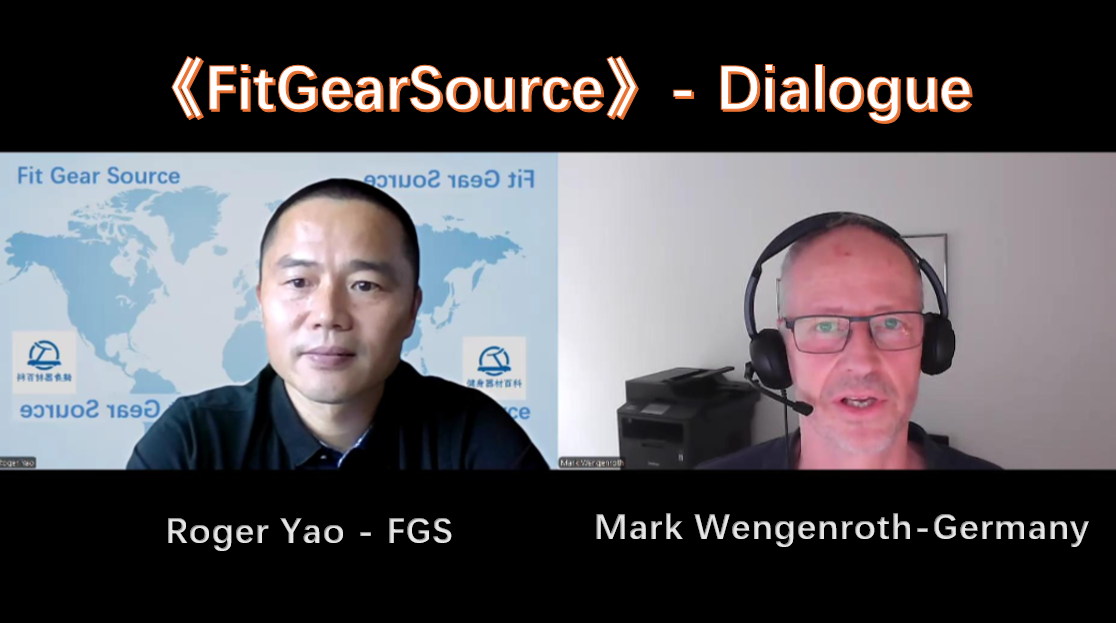
Welcome to FitGearSource Dialogue. I’m Roger Yao, and today I’m honored to have Mark Wengenroth with us, an industry veteran with over 30 years of experience in sporting goods and fitness equipment.
Mark has worked with both European clients and Asian business partners, witnessing firsthand how “Made in China” evolved from OEM suppliers to global brand players. Today, we’ll discuss:
- How the EU fitness equipment and sporting goods market has changed
- Challenges faced by European home-use brands
- The role of Chinese brands in reshaping the market
- Entry strategies for Chinese fitness equipment manufacturers into Germany
Self-introduction
Roger: Mark, before we start, could you introduce yourself first?
Mark: Sure. Right now, I design small gym solutions for hotels and retirement homes, always tailored to the specific guest group. For instance, senior guests (60+) benefit from bikes and resistance bands, while seminar hotels with younger visitors need treadmills, rigs, and dumbbells.
I’m also working on a “Well-Being Solution” concept for a European buying association, rethinking how fitness and sporting goods are presented in retail stores. It’s still in early development but could reshape customer experience.
Q1: First Trip to China
Roger: When was your first trip to China? What was your impression?
Mark: My first trip was in 1996, when I was a buyer at KarstadtSport. I visited Beijing, Shanghai, and South China. Strangely enough, the moment I stepped out of the airport, I felt “at home.” It was both unusual and welcoming—and marked the beginning of my long relationship with China.
Q2: Evolution of Sino-EU Cooperation
Roger: How has cooperation between China and Europe evolved over the past 30, 20, and 10 years?
Mark: China has gone through a continuous transformation. People often said “Chinese quality was poor 30 years ago,” but in reality, poor quality often resulted from Western buyers pushing only on price. If both sides worked together on strategy and product development, the result was always good quality at reasonable cost.
What impressed me most was how fast China developed infrastructure and production capability. Today, Chinese fitness equipment manufacturers are no longer just OEM suppliers—they’re global brand owners.
Q3: Sporting Goods & Fitness Equipment Experience
Roger: You transitioned from camping and outdoor to fitness equipment. Can you share that journey?
Mark: Yes. From 1994 to 2001, I was a buyer at KarstadtSport. Later, I developed SEVYLOR (inflatable boats and SUPs) in Germany for a Chinese factory owner who also had fitness brands: ROCK-Fitness, Extreme Fitness, and Powertec.
Due to ISO standards, Rock and Extreme couldn’t enter, but I successfully launched Powertec in Europe (2008–2013). Later, from 2014 to 2018, I developed Spirit, X-Terra, and Dyaco Medical in the DACH region.
Roger: Did European customers accept Chinese fitness equipment brands back then?
Mark: Yes, but only if presented with a unique selling proposition (USP) and strong after-sales service. If you positioned only on “lowest price,” customers rejected it.
Q4: The EU Market Today
Roger: Many German brands like KETTLER went bankrupt. Some blame cheap Chinese imports on Amazon, others blame internal issues. What’s your view?
Mark: Mismanagement was the bigger issue. Some German brands assumed people would “always buy German.” But Asian manufacturing improved dramatically—similar to the auto industry, where BYD, NIO, XPeng, and even Xiaomi are now entering Germany.
E-commerce lowered prices but increased return rates. I know brands with a 25%+ return rate, losing €500k despite €5m turnover. After my advice to focus on higher quality and margin, turnover dropped to €900k but profits rose to €200k.
Also, That’s proof that Chinese fitness equipment manufacturers can succeed with the right strategy……
Q5: Entry Strategies for Germany
Roger: For commercial fitness equipment brands entering Germany, is it better to set up a local team or work through distributors?
Mark: There are three options, with Pros and Cons, of course.
- Local rep + showroom gym: Low cost but weak presence and no secure after-sales service
- Work with distributors: Cheapest entry but no control over branding and strategy
- Set up a German subsidiary (GmbH) with office, warehouse, and showroom: High trust and visibility but high investment
Best case is about Johnson,
Johnson Health Tech (Matrix, Vision, Horizon). They invested early in Germany and many other countries, with warehousing, after-sales service, and strong brand building across commercial, semi-commercial, and home-use markets.
Q6: Can Chinese Brands Replicate Johnson?
Roger: Can Chinese brands copy Johnson’s model?
Mark: Not necessary. Johnson is huge, but too slow to catch niche trends now. Other Chinese fitness equipment brand owners should focus on niche markets, with the right strategy, patience, and capital. Success is very possible.
Q7: Final Advice
Roger: Finally, what advice do you have for Chinese fitness equipment manufacturers entering Europe?
Mark: The EU market is competitive but full of opportunities. Asians—especially Chinese brands—have the advantage of mentality and adaptability. They’re willing to learn and adjust, unlike some American companies that “believe they already know everything.”
My advice:
- Build a long-term strategy;
- Ensure after-sales service and spare parts in Europe;
- Position your fitness equipment brand beyond “low price.”
- With this approach, Chinese fitness equipment and sporting goods manufacturers will succeed in Europe.
Roger: Thank you, Mark, for your deep insights. We believe today’s dialogue will inspire more Chinese brands to pursue global expansion confidently.

0 Comments
No comments yet. Be the first to share your thoughts!
Leave a Comment