
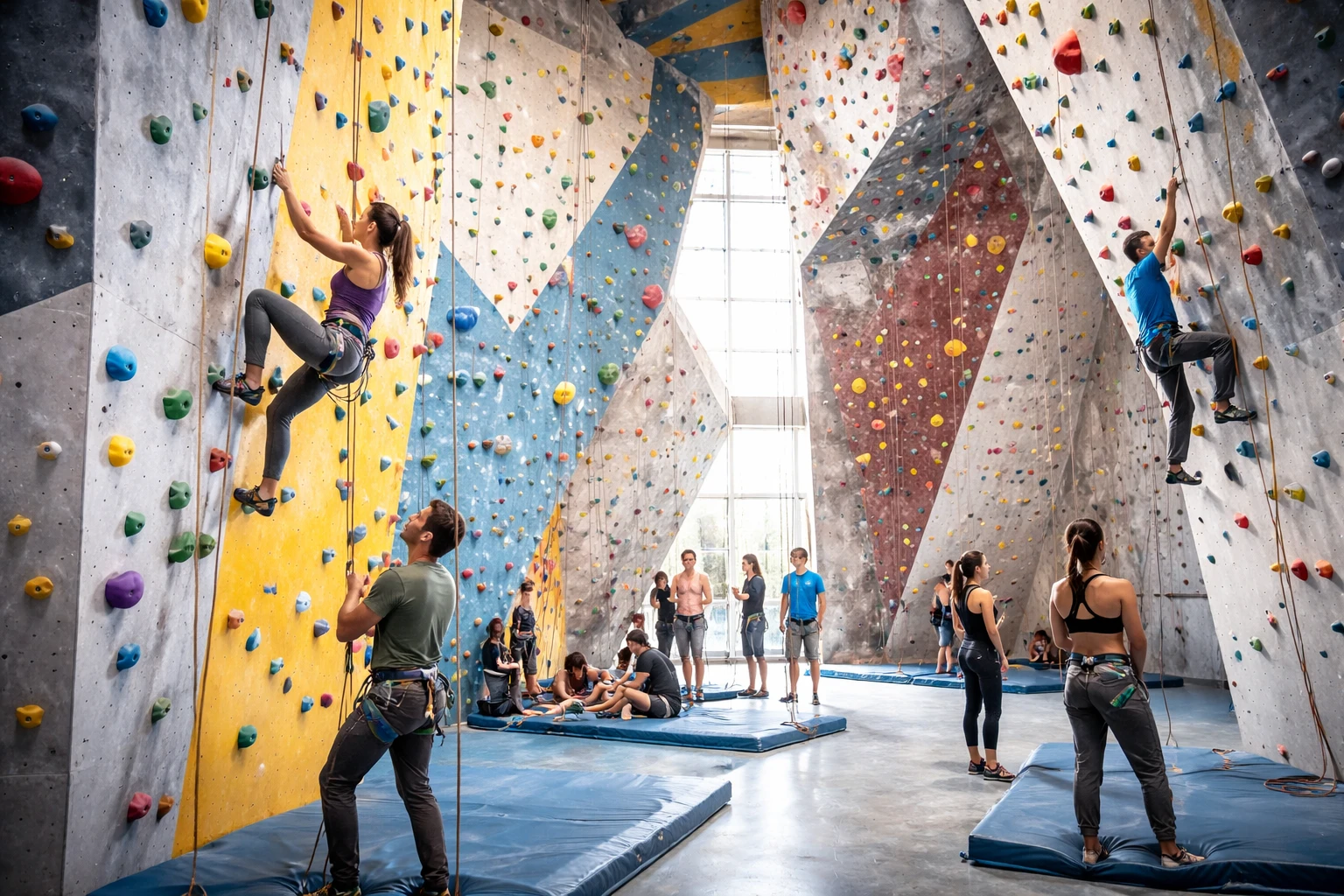
China has approved and released a new mandatory national standard, Open Conditions and Technical Requirements for Sports Venues – Part 4: Climbing Venues (GB 19079.4—2025). The announcement was made under Announcement No. 39 of 2025 by the State Administration for Market Regulation (Standardization Administration of China). The new standard will officially take effect on July 1, 2026, fully replacing the current GB 19079.4—2014 version.
The standard was proposed and administered by the General Administration of Sport of China, and jointly drafted by the Mountaineering Management Center of the General Administration of Sport and the Chinese Mountaineering Association, together with seven participating organizations including Beijing Hua’an United Certification & Testing Center Co., Ltd., Beijing Rocktime Climbing Sports Culture Co., Ltd., and Jiangsu Zhongzheng Testing Co., Ltd.
As a high-risk sport, climbing has experienced rapid growth in recent years. Data show that as of January 2025, there were 811 climbing venues in mainland China (excluding Hong Kong, Macao and Taiwan), representing a 27.5% year-on-year increase. Over the past decade, the 2014 version of the standard has played an important role in regulating venue operations and ensuring participant safety. However, with the industry’s fast expansion, shortcomings—particularly in facility load-testing methods—have become increasingly apparent.
To meet new industry demands and address safety gaps, the revision project was formally initiated in 2023 and completed over a two-year period. The revised standard specifies technical requirements for opening climbing venues, covering personnel qualifications, site and equipment conditions, environmental management, and safety assurance measures. For the first time, it systematically defines testing methods for key indicators such as structural load-bearing capacity, impact resistance of climbing panels, and axial tensile strength of bolt holes (anchor points).
The standard applies to the construction, operation, management, and inspection of all climbing venues open to the public, including both artificial and natural climbing sites. Compared with the 2014 edition, the revision focuses more closely on practical industry needs, addressing gaps in testing methodologies and refining safety requirements.
The new standard also clarifies core terminology such as climbing venues, top-rope belay systems, and lead climbing, while imposing stricter requirements on instructor qualifications, safety equipment configuration, and emergency management systems. In particular, it emphasizes that all high-risk activities must be equipped with inspected and certified safety equipment, and requires venues to conduct at least one emergency response drill annually to enhance risk prevention and control capabilities.
The release and implementation of this standard will further strengthen China’s sports venue standards system, provide authoritative technical support for the supervision of climbing venues, and promote the industry’s standardized and professional development. By reinforcing safety measures across multiple dimensions, the standard will better protect participants’ personal safety, support the healthy and sustainable growth of the climbing industry, and inject new momentum into China’s national fitness initiative.




Comments (0)
No comments yet, be the first to comment!