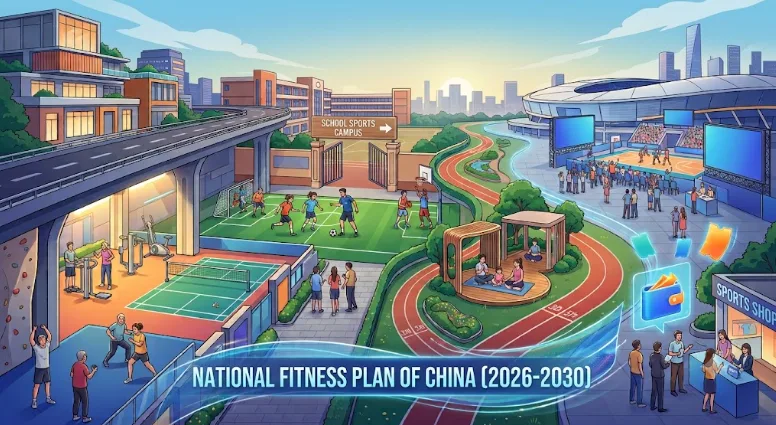
BEIJING — July10, 2026, China has officially approved its latest National Fitness Plan (2026–2030), a major regulatory blueprint poised to reshape the domestic sports and wellness landscape and unlock significant new opportunities across the broader fitness market.
The plan was reviewed and passed during an executive meeting of the State Council, chaired by Chinese Premier Li Qiang. The updated policy mandates a multi-channeled approach to boosting the supply of fitness facilities, accelerating sports initiatives in schools, hosting a wider array of grassroots community tournaments, and innovating health-centric consumer industries.
This move directly aligns with Chinese President Xi Jinping’s overarching vision that “national fitness is the foundation and guarantee for the people’s physical health and healthy lifestyle.” Moving forward, the policy is expected to inject fresh vitality into the country’s multi-billion-dollar wellness ecosystem.
A 30-Year Evolution: Elevating Fitness to a National Strategy
The announcement marks the latest milestone in a three-decade journey to institutionalize wellness in China. The foundation was laid in 1995 with the National Fitness Program Outline, which established a framework to harmonize public health with broader socio-economic growth. By 2009, public fitness entered a new era of legal standardization with the enactment of the National Fitness Regulations and the creation of an annual “National Fitness Day” on August 8.
The definitive turning point for the commercial fitness market, however, occurred in 2014. The State Council issued a landmark directive on accelerating the sports industry and promoting sports consumption, elevating national fitness to an official national strategy. Since then, the government has steadily rolled out targeted five-year initiatives. The consecutive execution of the 2011–2015, 2016–2020, and 2021–2025 plans has successfully shifted the country away from a niche sports culture toward a highly collaborative, innovation-driven public service model.
Data Insights: The Impact of the “14th Five-Year” Boom
Driven by continuous policy support, localized government entities and private sectors have aggressively expanded the country’s fitness infrastructure. By the conclusion of the 14th Five-Year Plan cycle at the end of 2025, China’s fitness infrastructure reached unprecedented scales. The nation boasted 5.0037 million sports and fitness venues, covering a total surface area of 4.372 billion square meters. This pushes the per capita sports area to 3.11 square meters. Furthermore, more than 1,500 dedicated sports parks were constructed and put into service over this five-year period, comfortably exceeding the state’s initial target of 1,000 parks.
This infrastructure boom has yielded tangible improvements in public health and consumer habits. According to the latest national physical fitness monitoring data, 84.9% of the population achieved a “qualified” fitness standard or higher by the end of 2025—a 0.8 percentage point increase compared to 2020. Active participation is also rising, with 38.52% of residents aged seven and above now exercising regularly, marking a 1.3 percentage point growth from 2020. These metrics coincide with broader demographic shifts; China’s average life expectancy reached 79.25 years by late 2025, rising by 1.32 years over the five-year period at an average annual clip of 0.26 years.
The Next Frontier: Shifting Focus from Volume to Value
Despite impressive metrics, industry analysts note that the fitness market is entering a critical transition phase. Structural challenges persist, notably regional and rural-urban imbalances in infrastructure distribution. There remains a shortage of certified, professional fitness coaching, structured organizational support, and sustainable service models at the grassroots level.
Addressing these disparities—moving beyond simply building physical spaces (“quantity”) toward delivering premium experiences (“quality”)—is the primary task for the next era of development. Observers universally agree that the next phase of growth will be defined by the precise and targeted supply of fitness services rather than raw real estate expansion.
Looking Ahead: Mega-Events and the Outdoor Boom
The state’s upcoming macroeconomic guidelines outline a highly commercialized roadmap for the sports and wellness sector over the next five years. The national target is to ensure that approximately 40% of the population engages in regular physical exercise, with a heavy emphasis on youth fitness.
To achieve this, the government plans to enrich the supply of premium sports products and actively foster a “tournament economy” around amateur and professional events. The strategy also outlines plans to safely open up natural resources—including waterways, airspace, and mountainous regions—to outdoor adventure sports. Capitalizing on the legacy of the Beijing Winter Olympics, China will continue expanding its winter sports demographic while driving the overall sports and fitness industry into a new era of premium, sustainable growth.