

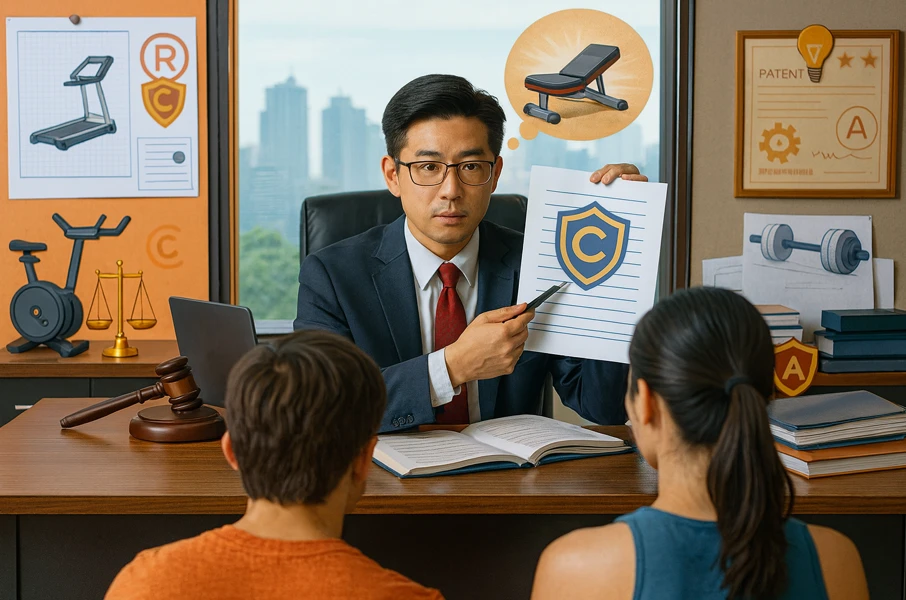
In the previous article, we provided a brief overview of the intellectual property rights that sports equipment companies commonly encounter in their daily operations. Intellectual property involves a wide range of rights and application scenarios. In the upcoming series, we will explain in detail the major types and characteristics of infringement corresponding to each category of intellectual property, helping companies avoid IP risks and protect their commercial interests.
I. Main Circumstances of Trademark Infringement
According to Article 57 of the Trademark Law, the following situations constitute an infringement of the exclusive right to use a registered trademark:
- Using a trademark identical to a registered trademark on the same goods without the permission of the trademark registrant;
- Using a trademark similar to a registered trademark on the same goods, or using a trademark identical or similar to a registered trademark on similar goods without permission, which is likely to cause confusion;
- Selling goods that infringe upon the exclusive right to use a registered trademark;
- Counterfeiting or unauthorized manufacturing of the registered trademark logo of another person, or selling such counterfeit or unauthorized logos;
- Changing a registered trademark without the consent of the trademark registrant and putting the goods with the altered trademark back into the market again;
- Providing convenience intentionally for others to infringe upon the exclusive right to use a registered trademark, helping others commit infringement;
- Causing other damage to the exclusive right to use a registered trademark.
From the above legal provisions, we can summarize several major characteristics and judgment criteria of trademark infringement:
1. Using a trademark identical or similar to the registered trademark
Although this criterion is expressed in just one sentence, in practice the determination of “identical or similar trademarks” varies widely. With the development of trademark practice, simple counterfeiting of identical trademarks or slightly modifying certain characters of a registered trademark for imitation has become very easy to identify.
Many businesses will make large-scale changes to the words or letters in a trademark while retaining certain identifiable design variations to achieve the effect of “passing off as the genuine brand.”
Therefore, the main standard for determining whether a trademark is identical or similar is whether ordinary consumers are likely to be confused. If the trademark is sufficient to cause ordinary consumers to confuse it with the registered trademark, it will be deemed identical or similar.
2. Use on identical or similar goods
In practice, whether goods are identical or similar is usually determined with reference to the Nice Classification of Goods and Services. Under this system, goods and services are divided into 45 classes, and each class contains multiple subclasses.
Each registered trademark is approved for use in specific classes. Once the goods fall within the approved categories of a trademark, the use will be deemed on identical or similar goods.
3. Without the permission or consent of the trademark owner
In business practice, many companies obtain trademark or brand authorization from distributors or agents rather than directly from the trademark owner. If any part of the authorization chain is defective, it may be judged as unauthorized trademark use and thus constitute infringement.
In addition, when using a registered trademark under authorization, exceeding the scope of authorization — including time, geographical area, products, and sales channels — may also constitute infringement.
II. How to Avoid Trademark Infringement Risks
Trademarks are a very “hard-core” type of intellectual property right. For brand owners, rights enforcement based on trademarks is typically fast, efficient, and capable of achieving high compensation.
For Chinese sports equipment companies, especially at a time when foreign brand owners are increasingly active in enforcement actions, strengthening preventive measures is crucial. Below, we introduce several small tips for avoiding trademark infringement risks:
1. Improve the company’s own trademark portfolio
China’s Trademark Law follows a “first-to-file” principle — the first to register is the first to receive legal protection. Regardless of a company’s size, trademark planning should be placed on the agenda.
Unlike simple trademark registration, trademark portfolio planning involves registering and arranging trademarks based on the company’s daily operational needs, including company names, brand names, product names, graphic designs, and other identifying elements, according to the company’s actual business scope.
Only with rights in hand can a company respond calmly and confidently when accused of infringement.
2. Carefully verify the trademark authorization chain
Many OEM manufacturers or agencies/distributors may think: if we do not use our own brand, do we still need to care about trademark law? The answer is yes.
For such companies, verifying the completeness and validity of the trademark authorization chain is extremely important.
If infringement arises due to defects in authorization, the company may still bear liability for damages. Additionally, OEM manufacturers must strictly follow order quantities and product types—overproduction beyond the order may also lead to IP infringement risks.
3. Conduct thorough infringement risk assessment in daily operations
There are numerous intellectual property rights, and for trademarks alone, hundreds of thousands of new applications are filed every month in China. Therefore, companies should actively seek help and support from professionals during daily operations.
When developing new products or initiating new production and business plans, companies need to search for, analyze, and assess potential trademark infringement risks. When necessary, they may need professionals to negotiate trademark coexistence, trademark purchases, and other matters to reduce risks and ensure safety.
Due to space limitations, this article cannot cover all aspects of trademark legal risks. In addition, trademarks intersect with copyright, unfair competition, names and portraits of famous individuals, and other areas — all of which can have significant impacts on the operations of sports equipment companies. When dealing with related matters, companies are advised to consult professional legal advisors and seek legal opinions.
About the Author
Yang Lun
Consultant Lawyer, Longan Law Firm (Guangzhou)
Email: yanglun@longanlaw.com
Mr. Yang graduated from Sun Yat-sen University School of Law and Vanderbilt University Law School, earning his LL.B. and LL.M., respectively. Since beginning his practice, he has focused on foreign-related intellectual property law and cultural and sports law.
He has represented multiple sportswear, sporting goods, and sports equipment companies in trademark, copyright, and patent administrative protection, customs/border protection, criminal reporting of infringement, and civil litigation.
He is recognized as a Rising Talent in Foreign-Related Legal Practice by the Guangdong Lawyers Association and also holds qualifications as a sports agent and a national Class-II volleyball referee.




















Comments (0)
No comments yet, be the first to comment!