

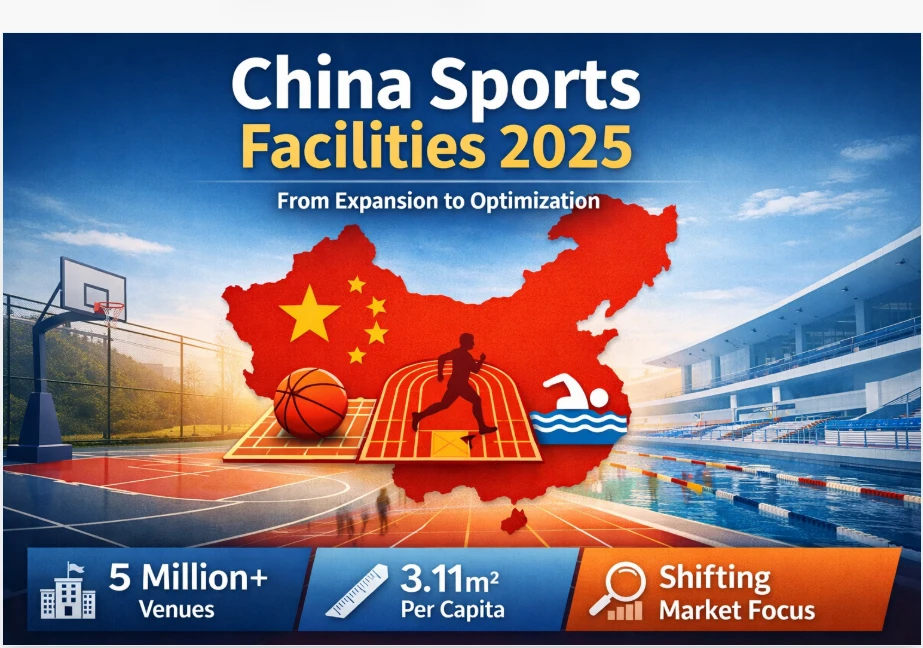
According to the latest National Sports Facilities Statistical Survey (2025) released by the General Administration of Sport of China recently, the country’s sports infrastructure continues to expand steadily, reaching a new milestone in both scale and accessibility.
By the end of 2025, China recorded 5.0037 million sports venues, with a total area of 4.372 billion square meters. The per capita sports facility area increased to 3.11 sqm, up by 0.11 sqm compared to 2024.
These figures not only reflect continued growth, but also signal a deeper transition—from rapid expansion toward structural optimization.
________________________________________
1. Growing Scale, but Still Room for Improvement
China’s sports infrastructure has clearly entered a stage of large-scale coverage. With more than 5 million venues nationwide, access to sports facilities has significantly improved across urban and rural areas.
However, the per capita figure of 3.11 sqm indicates that the country is still in a “mid-stage” compared to more developed markets. While the quantitative gap is narrowing, qualitative improvements—such as facility standards, usability, and distribution—are becoming increasingly important.
From an industry perspective, this ongoing expansion continues to lay the foundation for long-term growth in sports participation, fitness services, and equipment demand.
________________________________________
Infrastructure Structure: Traditional Facilities Still Dominate
A closer look at the structure reveals that track & field and swimming facilities remain the backbone of China’s sports infrastructure.
• Total track & field venues: 211,100
o Including 34,700 standard 400m tracks (16.45%)
• Total swimming venues: 40,700
o Outdoor pools: 20,800 (51.14%)
o Indoor pools: 18,900 (46.50%)
These figures indicate that China’s sports infrastructure is still largely built around public and school-based systems, focusing on accessibility and basic functionality.
At the same time, the relatively low proportion of standardized and high-performance facilities suggests that professional training environments and competitive infrastructure still have room to grow.
For the industry, this represents a clear opportunity for upgrading toward higher-specification facilities and more specialized use cases.
________________________________________
Ball Sports: The Core of Mass Participation
Among all categories, ball sports facilities dominate the landscape.
• Basketball courts: 1.2527 million
• Table tennis venues: 1.1407 million
• Badminton courts: 316,400
• Football pitches: 165,800
• Volleyball courts: 121,000
This distribution highlights a fundamental characteristic of China’s sports market:
mass participation, low-barrier activities remain the primary driver of infrastructure development.
Basketball and table tennis, in particular, benefit from strong cultural adoption, lower investment thresholds, and high utilization rates.
In contrast, football facilities remain relatively limited, reflecting both structural imbalance and potential policy-driven growth opportunities.
For manufacturers and suppliers, this translates into:
• Stable, long-term demand for basic sports equipment
• Selective growth opportunities in professional and policy-driven segments
________________________________________
Ice & Snow Sector: Entering a Rational Adjustment Phase
Unlike the continued growth in mainstream categories, the ice and snow segment shows early signs of adjustment.
• Ice rinks: decreased from 1,764 to 1,723
• Ski resorts: decreased from 914 to 903
After a period of strong policy support and investment—particularly around the Winter Olympics—this segment is now transitioning toward a more market-driven phase.
Given the high capital intensity, long payback cycles, and regional limitations of ice and snow projects, future development will depend more on sustainable demand rather than policy momentum alone.
This shift has important implications for both investors and equipment providers, requiring more cautious and strategic positioning.
________________________________________
Public Fitness Infrastructure: The Most Stable Growth Engine
In contrast, public fitness infrastructure continues to demonstrate consistent and stable growth:
• Public fitness paths: 1.1329 million
• Public/community gyms: 156,300
• Fitness trails: 182,000 routes / 43,030 km
These facilities are directly embedded in everyday life, serving as the foundation for daily physical activity and long-term health behavior.
Unlike specialized or high-end facilities, public fitness infrastructure benefits from:
• High frequency of use
• Broad accessibility
• Strong alignment with national health policies
For the industry, this segment represents a reliable and scalable demand base, particularly in community and lower-tier markets.
________________________________________
Conclusion: From “Building More” to “Using Better”
China’s sports infrastructure has now reached a significant scale milestone. However, the next phase of development will be defined not by how many venues are built, but by how effectively they are used.
The industry is gradually shifting from:
• Quantity-driven expansion
to
• Efficiency, utilization, and user engagement
For equipment manufacturers and solution providers, this means that hardware alone is no longer sufficient. The future will increasingly depend on the ability to integrate into real usage scenarios, enhance user experience, and connect with data and services.
Infomation Source: Sport.Gov.Cn


























Comments (0)
No comments yet, be the first to comment!