

China Sports Rehabilitation Market Report
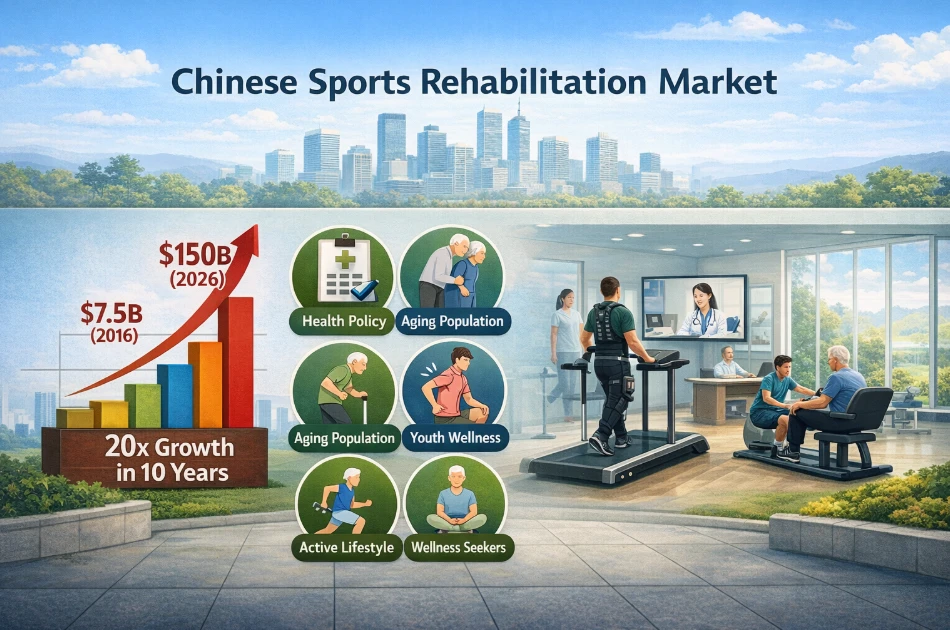
Over the past decade, China’s sports rehabilitation industry has undergone a remarkably rapid expansion. From a market size of approximately RMB 5 billion (about USD 0.70 billion) in 2016, the sector is projected to exceed RMB 100 billion (about USD 14.08 billion) by 2026, representing more than twentyfold growth in ten years. This shift not only signals the rise of a new growth industry, but also reflects a broader transformation in China’s healthcare system—from a traditional disease-treatment model toward a more comprehensive health management model.
10 years ago, sports rehabilitation in China was still a relatively niche medical service, primarily serving professional athletes, sports practitioners, and a limited number of high-end consumers. Today, it has gradually entered mainstream society and become an increasingly important part of personal health management for the general public. In 2016, the “Healthy China 2030” Planning Outline formally incorporated sports rehabilitation into the national strategic framework, marking the beginning of a new phase driven by both public policy support and market demand.
Over the following decade, under the combined influence of supportive policy measures, demographic change, and the rapid expansion of mass fitness participation, China’s sports rehabilitation industry achieved a historic leap from a small emerging segment to a fast-growing mainstream market.
At the same time, the patient profile within rehabilitation services has been changing significantly. Traditionally, rehabilitation departments mainly served elderly patients and those recovering from surgery. In recent years, however, younger age groups have increasingly become part of the core patient base. Data show that people aged 18 to 44 now account for around 50% of rehabilitation patients, while those born in the 1990s and 2000s represent 15% to 30% of patients seeking treatment for cervical and lumbar spine problems. Against the backdrop of an aging population, the younger onset of chronic conditions, and the continued expansion of the fitness population, sports rehabilitation is evolving from a specialized medical service into a broad-based public health need.
Industry Development: A Decade of Transition from Policy-Led Growth to Technology-Driven Expansion
Looking back at the development of China’s sports rehabilitation industry, its growth can broadly be divided into three stages.
The first stage was the policy initiation period from 2016 to 2020. The release of the Healthy China 2030 Planning Outline in 2016 marked the first time that sports rehabilitation was formally included in China’s national health strategy. In the following years, supporting policies were introduced one after another. In 2017, the government began encouraging private and social capital to participate in the development of rehabilitation institutions, and in 2019 it further lowered market entry barriers for private healthcare providers, allowing private capital to enter the rehabilitation sector more actively. Under this policy support, market size expanded rapidly.
From 2016 to 2020, China’s sports rehabilitation market grew from approximately RMB 5 billion (USD 0.70 billion) to RMB 20 billion (USD 2.82 billion), representing a compound annual growth rate of around 25%. At the same time, the number of rehabilitation institutions also increased significantly. Even so, the industry was still at an early stage. Public awareness of sports rehabilitation remained low, the customer base was still concentrated among athletes and high-end users, and the severe shortage of qualified rehabilitation therapists became a major constraint on industry development.
The second stage was the demand transition period from 2021 to 2023. Around 2021, China’s National Health Commission, together with eight ministries and commissions and the State Council, introduced a series of policies that further clarified the development goals and core tasks of the rehabilitation medical system, reinforcing the strategic role of sports rehabilitation within China’s broader healthcare framework. At the same time, the COVID-19 pandemic from 2020 to 2023 created short-term disruption for the industry. Some rehabilitation institutions were forced to suspend operations temporarily, and overall business volume declined for a period. However, the pandemic also accelerated business model innovation, leading to the emergence and adoption of services such as online rehabilitation consultations and remote rehabilitation assessment.
Overall, despite the pandemic, China’s sports rehabilitation industry maintained relatively strong growth momentum. By 2023, the overall market size and the number of institutions had doubled—or in some cases nearly tripled—compared with 2020 levels, while the number of practitioners and service visits also increased significantly. During this period, market demand began to change in nature, with more consumers viewing sports rehabilitation not only as a treatment tool but also as an important means of preventive health management and posture correction.
The third stage is the technology-driven phase from 2024 to 2026. As artificial intelligence, digital healthcare, and rehabilitation robotics continue to advance, the sports rehabilitation sector has entered a period of faster technological ad



















Comments (0)
No comments yet, be the first to comment!