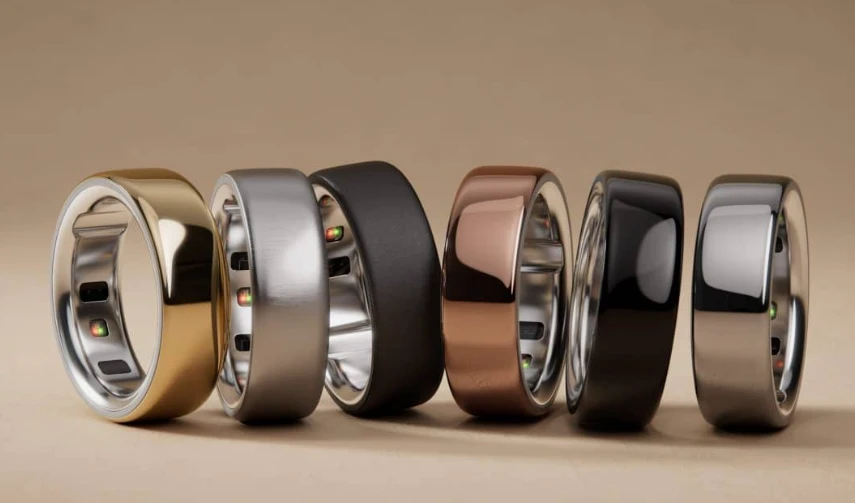
In the evolution of wearable technology, smart rings were once viewed as a niche gadget with limited appeal. However, as recent reports from Bloomberg indicate that smart ring pioneer Oura is secretly preparing for a U.S. Initial Public Offering (IPO), the market landscape for this form factor is being fundamentally rewritten.
According to reporting, the San Francisco- and Finland-headquartered company plans to raise up to $3 billion in an offering that could value the 900+ employee firm at more than $16 billion. This valuation marks a staggering 50% surge from the $10.9 billion valuation assigned during its $875 million Series E round. The company’s top-line performance reflects this exponential trajectory: Oura generated $500 million in revenue in 2024, doubled that figure to roughly $1 billion in 2025, and is projected to approach $2 billion in 2026.
Evolving from a niche biohacking tool favored by tech executives to a multi-billion-dollar wearable heavyweight, Oura’s trajectory demonstrates the massive commercial potential of smart rings. Simultaneously, it signals the beginning of a fierce global market battle drawing in tech conglomerates, fitness brands, and Chinese hardware manufacturers alike.
Decoding Oura’s Breakthrough: From Sleep Tracking to Women’s Health and Full-Spectrum Wellness
Oura’s premium valuation is anchored in its successful brand repositioning and expanding product ecosystem.
Initially, the Oura Ring gained traction among high-net-worth tech enthusiasts due to its lightweight form factor and precise sleep, heart rate, and body temperature monitoring. However, its transition into a mainstream health and recovery platform drove its revenue scaling:
Women’s Health & Precision Health Integration: Oura expanded its feature set to include hormone tracking, cycle prediction, and perimenopause insights, establishing key partnerships across health platforms to tap into a broader consumer base.
Hardware-Plus-Subscription Model: Rather than relying solely on one-off hardware sales, Oura implemented a recurring SaaS subscription model for full app functionality—a high-margin revenue structure favored by public market investors.
Despite its rapid growth, Oura faces operational headwinds. A proposed class action lawsuit filed in San Francisco accuses the company of misleading consumers regarding the precision of its sleep staging features, claiming that accurate sleep staging requires clinical-grade EEG scalp electrodes and eye sensors. Oura has pushed back against these claims, stating that its sleep staging algorithms have been validated and favorably compared against polysomnography—the clinical gold standard—in multiple independent third-party studies. Nevertheless, the legal challenge underscores the regulatory and scrutiny risks consumer wearables face when making advanced health monitoring claims.
A Crowded Field: The Smart Ring Sector Enters a New Era of Competition
As smartwatch growth decelerates and market saturation sets in, screenless, lightweight smart rings with multi-day battery life have emerged as the next major growth vector in wearables.
The competitive landscape is expanding rapidly beyond Oura:
- Tech Giants Entering the Fray: Consumer electronics major Samsung launched its Galaxy Ring, leveraging its hardware supply chain and ecosystem integration to capture market share.
- Fitness-Focused Competitors: Fitness band manufacturer Whoop executed a similar pivot, integrating hormone tracking and blood panel testing for thyroid and perimenopause health, driving its valuation to $10 billion.
- Specialized & Regional Players: Emerging brands like Ultrahuman, Noise, and NFC-enabled payment ring makers are carving out market share across distinct price points and functional niches.
Global industry analysts project the smart ring market to expand at a compound annual growth rate (CAGR) of 25% to 29%, growing from a few hundred million dollars into a $3 billion to $7 billion industry by the early 2030s. While North America currently accounts for over 45% of global market revenue, the Asia-Pacific region is forecasted to deliver the fastest growth rate in the coming years.
Chinese Hardware Players Enter the Ring: Impulse Unveils AI Smart Ring
Recognizing this market trajectory, agile Chinese fitness equipment manufacturers and smart hardware developers are accelerating their entry into the global smart ring arena.
A notable example is Impulse, a Qingdao-headquartered fitness equipment manufacturer:
- Impulse officially broke ground on its Smart Fitness and Wellness Equipment R&D and Manufacturing Base in the Haikou National High-Tech Industrial Development Zone. The first phase represents a 298.6 million yuan (~$42 million) investment focused on smart commercial, residential, and rehabilitation equipment.
- During the launch event, Impulse established the Global Health Technology Ecosystem Alliance alongside international partners such as the Indonesian Olympic Committee and The Hong Kong Polytechnic University. Crucially, in partnership with Photonics, Impulse inaugurated an AI Health Technology Innovation Center and officially unveiled its “Infinite Energy” AI Sports & Health Smart Ring.
This product rollout illustrates a broader strategic shift among Chinese hardware manufacturers: moving from traditional OEM/ODM mechanical equipment exports toward integrated “Hardware + AI Algorithms + Wearable Ecosystems.”
Chinese manufacturers possess distinct structural advantages that could allow them to capture market share:
- Robust Microelectronics Supply Chains: China’s mature hardware supply chain—spanning low-power Bluetooth chips, high-precision PPG optical sensors, micro-batteries, and precision metallurgy—enables rapid scaling, competitive pricing, and fast iteration cycles.
- B2B & Enterprise Ecosystem Integration: Unlike consumer-focused brands targeting direct-to-consumer (D2C) channels, commercial gym manufacturers can pair smart rings directly with commercial gym equipment, corporate wellness programs, and institutional athletic facilities, creating a connected hardware-and-data ecosystem.
- Global Logistics & Trade Infrastructure: Leveraging free trade frameworks like the Hainan Free Trade Port, Chinese companies are positioning their smart ring offerings for international distribution, combining AI-driven analytics with global brand partnerships.
Summary and Outlook
Oura’s $16B+ IPO target serves as a validation for the commercial viability of continuous, ring-based health monitoring. Over the next three to five years, market leadership in the smart ring space will be determined by three key factors:
Algorithmic Accuracy & Regulatory Compliance: Balancing miniaturized hardware design with clinical-grade data precision while navigating consumer protection and health data regulations.
Ecosystem & Cross-Device Integration: Connecting ring telemetry seamlessly with smartphone operating systems, smart home platforms, and commercial workout machinery.
Price Accessibility & Adoption: Lowering barrier-to-entry costs to drive mass-market adoption beyond early adopters and subscription-based tiers.
While Oura’s upcoming listing highlights the maturation of the smart ring category, the entry of established hardware manufacturers like Impulse signals that the global competition for the finger-worn wearable market is only just beginning.