The European fitness industry reached record highs in 2024, recovering strongly from the pandemic slump. Total membership across Europe grew to 71.6 million in 2024 (up from 67.7 million in 2023) (Europe’s Fitness Market Keeps Growing. It’s Likely Just Scratching the Surface – Athletech News).
Industry revenues in Europe climbed about 10% to €36 billion in 2024 (Europe’s Fitness Market Keeps Growing. It’s Likely Just Scratching the Surface – Athletech News), exceeding the last pre-pandemic peak. Major markets like Germany (11.7 million members) and the UK (11.5 million) led in absolute size (Europe’s Fitness Market Keeps Growing. It’s Likely Just Scratching the Surface – Athletech News), each now roughly back to pre-2020 membership levels. This reflects a robust rebound as consumers return to gyms in large numbers.
Germany remains the single largest fitness market in Europe by membership, with 11.71 million members recorded at the end of 2024 (Membership numbers in fitness clubs back to pre-covid levels: edelhelfer beratung).
This represents a +3.6% annual growth, marking a full recovery to pre-COVID participation. German gym penetration is estimated around 14% of the population, on par with the UK and higher than the 8–9% European average (Fitness Industry 2025: Key Trends & Statistics | PerfectGym Blog) (Europe’s Fitness Market Keeps Growing. It’s Likely Just Scratching the Surface – Athletech News).
Annual industry revenue reached €5.82 billion (net) in 2024, a new all-time high (Membership numbers in fitness clubs back to pre-covid levels: edelhelfer beratung). Notably, the average monthly gym membership fee in Germany has risen to about €46.95 (gross), with chain gyms averaging ~€38 (gross) per month (Membership numbers in fitness clubs back to pre-covid levels: edelhelfer beratung) – indicating both customer willingness to invest in fitness and operators’ pricing power.
Several industry dynamics have underpinned this growth. First, there is a sustained consumer focus on health and wellness: gyms have solidified their role as “reliable partners” in health promotion and preventative care (Membership numbers in fitness clubs back to pre-covid levels: edelhelfer beratung).
About 43% of German fitness facilities now offer corporate health programs for companies (Membership numbers in fitness clubs back to pre-covid levels: edelhelfer beratung), integrating fitness into workplace wellness. Second, the sector has shown economic resilience – demand for fitness remains strong despite broader economic challenges (Membership numbers in fitness clubs back to pre-covid levels: edelhelfer beratung).
Third, digitalization is accelerating: roughly 24% of gym contracts in Germany were signed online in 2024 (up from 14% a year prior) (Membership numbers in fitness clubs back to pre-covid levels: edelhelfer beratung), and many operators have introduced apps and hybrid offerings. This blend of robust consumer interest and adaptive business strategies has fueled the market’s return to growth.
Another key trend has been consolidation and scaling among gym operators (detailed in the next section). Large gym chains and franchisors expanded aggressively in 2023–2024, both organically and via acquisitions. Europe saw over a dozen major M&A deals in 2023 alone (Fitness Industry 2025: Key Trends & Statistics | PerfectGym Blog), reflecting high investor confidence in gym chains.
In the German market, the big operators captured most of the post-pandemic growth, as we will see with the Top 10 brands. Meanwhile, smaller independent studios have faced tougher competition. Overall, the stage is set for fewer, larger players commanding a growing share of Europe’s push toward 100 million health club members by 2030 (Europe’s Fitness Market Keeps Growing. It’s Likely Just Scratching the Surface – Athletech News).
A Decade of Growth and Consolidation in Germany (2014–2024)
Over the past decade, Germany’s fitness club landscape has undergone significant consolidation. Large fitness chains grew much faster than the rest of the market, resulting in a massive shift in market share. In 2014, the ten largest operators accounted for only about 27% of all gym members in Germany (Top 10 Fitness Operators in Germany: edelhelfer beratung).
By the end of 2024, the Top 10 operators hold nearly half of all members (~46%) (Top 10 Fitness Operators in Germany: edelhelfer beratung). In absolute terms, their combined membership more than doubled – from roughly ~2.5 million in 2014 to 5.4 million in 2024 (Top 10 Fitness Operators in Germany: edelhelfer beratung) (Top 10 Fitness Operators in Germany: edelhelfer beratung) – even as total national membership grew more modestly.
Figure 1 illustrates this consolidation: the Top 10’s share of total memberships expanded from about one-quarter to almost one-half over the decade.
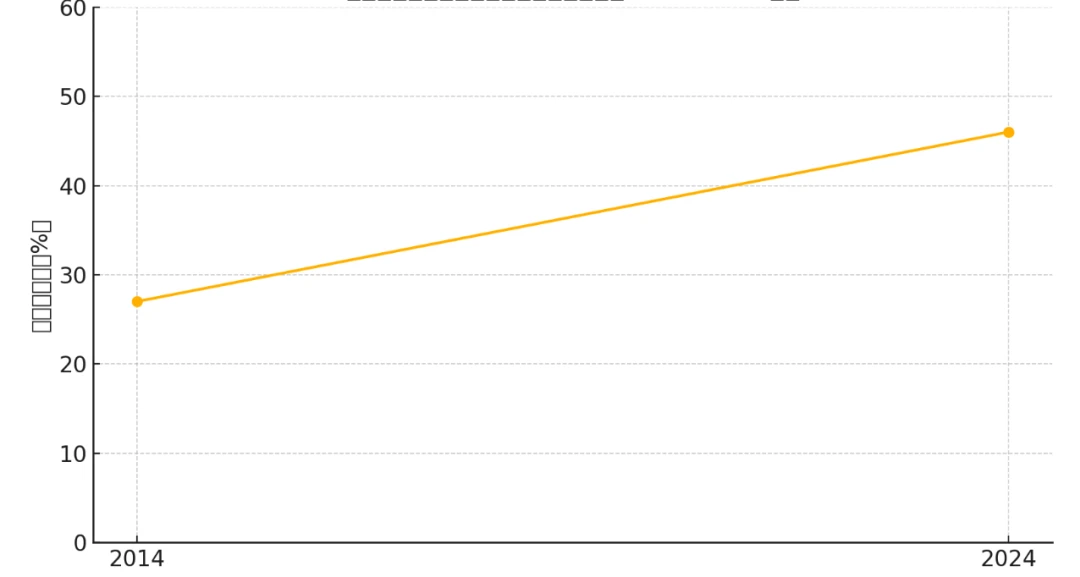
Figure 1: Top 10 operators’ share of total gym memberships in Germany, 2014 vs 2024. In 2014, the leading chains held just 27% of memberships, whereas by 2024 they command ~46% – nearly half of the market (Top 10 Fitness Operators in Germany: edelhelfer beratung). This reflects rapid growth of large chains outpacing the rest of the industry.
This concentration was driven by both organic expansion and mergers/acquisitions. According to industry surveys, the largest fitness companies added around 2.9 million members since 2014, while the rest of the market barely kept pace or even saw declines in some segments (Top 10 Fitness Operators in Germany: edelhelfer beratung).
The Top 10 operators collectively expanded their club count from just under 900 locations in 2014 to almost 1,600 in 2024 (Top 10 Fitness Operators in Germany: edelhelfer beratung). In other words, the big chains opened or acquired approximately 700 new gyms in Germany over ten years, even as the total number of facilities nationwide remained relatively flat (~9,127 clubs in 2024, vs ~9,000 in 2014) (Membership numbers in fitness clubs back to pre-covid levels: edelhelfer beratung).
The average club size (by membership) for these top operators has also grown. In 2014, an average Top 10 club had ~3,400 members, already well above the industry-wide average. Today, an average Top 10 club has about 3,400 members as well – roughly three times the member count of the average German gym (Top 10 Fitness Operators in Germany: edelhelfer beratung). This gap underscores how large-format, high-volume gyms have become the dominant model.
Indeed, low-cost high-volume chains led the growth. Many of the Top 10 brands operate in the budget segment, using large footprint gyms to enroll thousands of members at affordable rates.
For example, FitX (now the #2 operator) averages about 9,500 members per club – one of the highest in Europe (Top 10 Fitness Operators in Germany: edelhelfer beratung). In contrast, smaller independent gyms or specialized studios often have just a few hundred members.
Figure 2 compares the approximate membership per location for the Top 10 operators. Chains like FitX and McFIT (RSG Group) reach over 6,000–9,000 members per club on average, whereas even other top franchises (clever fit, EASYFITNESS) operate with ~1,500–2,500 members per club. This polarization in scale has widened in the past decade.
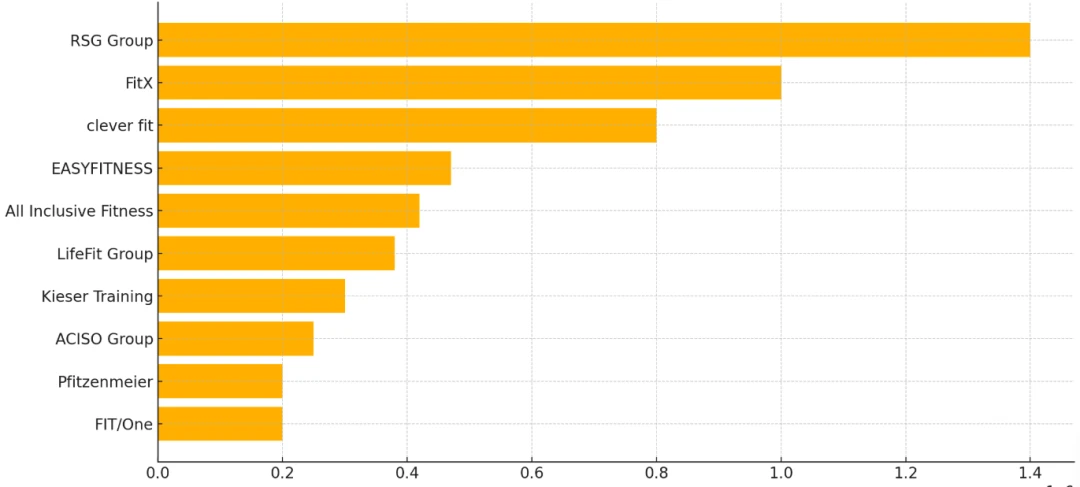
Figure 2: Average number of members per gym location for Germany’s Top 10 operators (2024). High-volume budget chains like FitX achieve ~9,500 members per club – far above the Top-10 average (~3,400) (Top 10 Fitness Operators in Germany: edelhelfer beratung) (Top 10 Fitness Operators in Germany: edelhelfer beratung).
RSG Group (McFIT/John Reed) and FIT/One also exceed 6,000 members per club on average. By contrast, franchise networks such as clever fit and EASYFITNESS have ~1,800–2,300 members per club, and specialized or regional players (e.g. Kieser Training, ACISO’s Injoy network) are on the lower end.
Major operators used acquisitions and new concepts to fuel growth.
In 2014, the market was dominated by one giant – McFit (RSG Group) – which alone comprised over 40% of the Top 10’s members at that time (Top 10 Fitness Operators in Germany: edelhelfer beratung).
Over the next decade, RSG continued to expand (including internationally), but several new players surged up the ranks.
FitX, for example, was a relatively small newcomer in 2014 with under 100k members; it grew more than tenfold to over 1 million members by 2024 (Top 10 Fitness Operators in Germany: edelhelfer beratung). FitX wasn’t even in the Top 10 a decade ago – now it is the second-largest chain in Germany.
Other fast-rising groups include the BestFit Group (now branded “all inclusive fitness”), which did not exist in its current form in 2014 but is now a Top 5 operator after a series of mergers (Top 10 Fitness Operators in Germany: edelhelfer beratung), and the LifeFit Group, which formed by consolidating premium clubs and is rapidly scaling (more on these below).
Meanwhile, established chains pursued diversification and acquisitions. RSG Group (which owns McFIT) introduced new club concepts – High5 (2015), John Reed (2016), and John’s Bootcamp (2018) – to broaden its appeal beyond the original low-cost McFIT model (Top 10 Fitness Operators in Germany: edelhelfer beratung).
RSG’s most significant move was the acquisition of Gold’s Gym in 2020, a famous global brand, adding a franchise network of ~3 million members worldwide to its portfolio (Top 10 Fitness Operators in Germany: edelhelfer beratung). This made RSG a global player. Others took a franchise route: clever fit and EASYFITNESS aggressively expanded their franchise networks, together now operating over 640 gyms in Germany (nearly 40% of all Top 10 facilities) (Top 10 Fitness Operators in Germany: edelhelfer beratung).
Large fitness investors also entered the German market – for instance, Nord Holding has backed BestFit Group since 2013, and Waterland (a private equity firm) acquired LifeFit Group in 2023 (Top 10 Fitness Operators in Germany: edelhelfer beratung), facilitating faster expansion through capital injection.
This consolidation has squeezed mid-sized operators and increased the dominance of big brands. Many independent gyms joined franchise systems or were bought out. Even Migros (Switzerland’s retail giant) attempted to build a German fitness foothold by acquiring the INLINE/Injoy franchise system and creating the ACISO Group, which itself went through further acquisitions and a PE buyout (details below) (Top 10 Fitness Operators in Germany: edelhelfer beratung).
By 2024, seven of the Top 10 operators in Germany can be considered low-cost or value-focused chains, and the remaining three (LifeFit/Fitness First, Kieser, Pfitzenmeier) compete by specializing in either premium services or health niches. The market has clearly stratified: a few large budget chains capture mass-market demand, while a handful of differentiated players carve out sizeable segments.
Looking ahead, consolidation is expected to continue. The Top 10 operators collectively grew memberships by +6.8% in 2024 (Top 10 Fitness Operators in Germany: edelhelfer beratung), outpacing the overall market growth. Based on their current expansion plans, the Top 10’s member count and market share will likely keep rising in 2025 (Top 10 Fitness Operators in Germany: edelhelfer beratung).
Many of these companies have active development pipelines (new club openings) or are pursuing further acquisitions. In fact, some major deals were announced in early 2025 – for example, LifeFit Group’s takeover of FIT/One (ranked #9) (Top 10 Fitness Operators in Germany: edelhelfer beratung). Such moves will shuffle the rankings and concentrate the market even further.
New challengers (including foreign entrants) could also emerge, but any newcomer must achieve scale rapidly to compete with the entrenched giants. In summary, the past decade transformed Germany’s fitness industry from a fragmented market into one dominated by a few powerful brands – a trend that shows no sign of slowing down.
Top 10 Fitness Club Operators in Germany (2024)
By the end of 2024, the ten largest fitness club brands in Germany served 5.40 million members across nearly 1,600 gym locations (Top 10 Fitness Operators in Germany: edelhelfer beratung) (Top 10 Fitness Operators in Germany: edelhelfer beratung). Table 1 below ranks these Top 10 operators by membership size. All ten achieved membership growth in 2024, ranging from mid-single-digit to double-digit percentages – notably, LifeFit Group posted the fastest growth, followed by BestFit (“all inclusive fitness”) and clever fit (Top 10 Fitness Operators in Germany: edelhelfer beratung). The profiles that follow detail each operator’s scale, recent performance, and strategic highlights.
Table 1: Top 10 Fitness Club Brands in Germany (2024) – Ranked by number of members. (Membership figures are as of end 2024. “Clubs” indicates number of gym locations in Germany.)
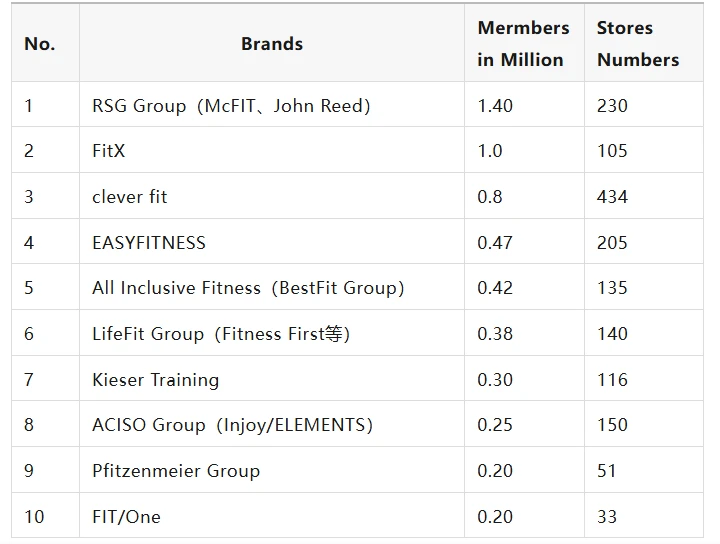
Sources: Company reports and industry analyses (Top 10 Fitness Operators in Germany: edelhelfer beratung) (Unternehmen | EASYFITNESS). Estimates (est.) are analyst estimates based on available data and recent growth rates. FIT/One’s member count (~220k across DACH) and club count (33 in Germany) are prior to its 2025 merger with LifeFit (Merger of FIT/One and LifeFit Group contractually sealed | Waterland).
1. RSG Group (McFIT, John Reed, Gold’s Gym, etc.)
RSG Group is the long-standing market leader in Germany’s fitness industry, with around 1.4 million members nationwide (Top 10 Fitness Operators in Germany: edelhelfer beratung). Founded by Rainer Schaller and originally known as McFIT, the company has evolved into a multi-brand global fitness empire.
In Germany, RSG operates approximately 200–230 clubs under various brands, including the flagship McFIT gyms (high-volume, low-cost fitness centers), the stylish John Reed Fitness clubs (