
Why Final Inspection Alone Often Fails in Fitness Equipment Quality Management?
In global fitness equipment sourcing, Final Inspection (pre-shipment inspection) is one of the most widely used quality control practices among international buyers. It is straightforward, relatively cost-controlled, and easy to execute, so it has long been treated as the “last line of defense” for supply-chain product quality.
Yet in day-to-day operations, some buyers repeatedly face the same confusing outcome: the inspection report says PASS, but once the products reach the market, customer complaints still surge. This is far from rare in the industry—and it often leads buyers to question the final inspection itself.
From a supplier quality management perspective, and drawing on the author’s years of hands-on experience and real cases in the fitness equipment sector, this article explains why relying on Final Inspection alone is unlikely to truly protect product quality, and it outlines practical directions for improving supplier quality management.
________________________________________
1) A recurring question: Why do products pass inspection, yet fail in the market?
In real work, buyers often raise a similar concern: they either have their own QC team or hire a third-party inspection company to perform pre-shipment inspections at factories in China. The reports show everything is qualified—yet once the products are on the market, complaints still appear in large numbers. A more direct question quickly follows: if that’s the case, does this kind of inspection still matter?
This is not an isolated case. In the fitness equipment industry—whether it is home treadmills or commercial strength training equipment—similar situations have occurred. Some programs passed every pre-shipment inspection, but within three months of launch, the repair rate exceeded 10%. Deeper investigations later showed the root cause was not appearance or assembly quality; instead, it came from unreasonable structural design or an incorrect selection of specifications for a critical component.
When this happens, buyers often point their doubts at the inspection itself: Was QC not executed carefully? Is the third-party inspection firm truly professional? Some even start thinking about whether they should cancel Final Inspection altogether.
However, from a quality management point of view, the issue is often not “inspection versus no inspection.” Rather, it is that the role of Final Inspection has been misunderstood.
________________________________________
2) Why can’t Final Inspection catch everything?
By nature, Final Inspection is a pre-shipment sampling verification. Its core function is to check selected samples after production is completed, confirm basic compliance with the contract or specifications, and decide whether the shipment can be released.
This is a typical “end-of-line gate.” But it is not a full, end-to-end quality control system. When buyers treat it as the only quality assurance method, risks inevitably accumulate.
First, sampling inspection always carries a certain level of escape risk. Most Final Inspections follow AQL or similar sampling plans, rather than 100% inspection. That means the samples selected may not represent the real quality level of the entire batch.
For example, a shipment of 300 treadmills was sampled with five units before shipping, and all results were qualified. Yet after two months in the market, more than 60 units experienced console/control board failures. The final investigation showed the issue came from a certain lot of capacitors with insufficient heat resistance. Defects like this usually do not appear in the short term, and sampling inspection is almost incapable of covering such latent risks.
Second, the inspection methods used in Final Inspection are inherently limited. At most factory sites, inspection relies on basic gauges, visual checks, and simple functional tests. It is rare to see professional equipment used for durability testing or environmental simulation. Meanwhile, the real operating conditions of fitness equipment are far more complex than the inspection environment—dynamic loads, long cycle usage, sweat corrosion, temperature and humidity variation, and all kinds of user misuse.
There was once a batch of indoor cycling bikes that appeared completely normal at pre-shipment inspection, but after three months in the market, abnormal noise complaints broke out at scale. The investigation showed that the grease used in the bottom bracket bearings did not meet the design specification and degraded quickly under high temperature and high-frequency usage. Such hidden issues are almost impossible to detect through short ride tests or static checks.
Third, the professional background of inspectors directly affects the effectiveness of inspection. Many third-party inspection firms are very familiar with general consumer products, but lack deep understanding of fitness equipment as a specialized category. They can usually identify cosmetic defects, packaging issues, or basic functional problems, yet struggle to judge performance risks in critical components, determine where Final Inspection should focus for a finished unit, or apply the industry’s practical acceptance criteria.
In some real cases, inspection tests were even performed by factory operators on behalf of inspectors, because inspectors were not familiar with how to operate the equipment. In other cases, product assembly was fully handled by the factory, while inspectors only performed surface-level checks.
More importantly, many quality problems belong to what can be called latent issues. Latent issues are defects that cannot be detected through routine inspection on finished goods before shipment, but gradually appear after a period of use. In fitness equipment, this is very common: bearing wear, insufficient motor life, cracked plastic parts, belt slippage, gradually increasing noise, and even downstream quality problems caused by packaging design that leads to deformation from compression during transportation.
These issues are closely related to time, usage frequency, and environmental conditions. Given the extremely limited time available on site before shipment, Final Inspection is almost unable to identify them. That is why simply increasing sampling quantity, adding a few more checks, or hiring more QC staff cannot fundamentally eliminate such latent quality risks.
________________________________________
3) In certain scenarios, the limitations of Final Inspection become even more obvious
Final Inspection works best for products with simple structures, single processes, large batch sizes, and stable production. But in real sourcing, many orders do not fit these conditions.
For example, in commercial fitness equipment procurement, a single order often includes more than ten different models of strength equipment, while each model may only have a handful of units. If AQL sampling is applied strictly, the number of units to be inspected becomes close to a full inspection, and both inspection time and cost climb rapidly.
In practice, to control cost and total working time, QC often does not participate in assembly. Instead, QC checks appearance and basic functions on units that have already been assembled. However, many critical issues happen precisely during assembly—such as dimensional deviations in parts, poor fit and alignment, or incorrect installation sequence. These problems can only be discovered when the equipment is actually assembled. Once that window is missed, Final Inspection can no longer act as an effective gatekeeper.
Another common situation is that even if issues are found at Final Inspection, effective rework is no longer easy. For instance, the main frame welding of a batch of strength equipment may deviate from the design, resulting in structural dimensions out of tolerance. Such defects often cannot be repaired easily; they require full disassembly and re-welding, which is almost equivalent to building the unit again. At that point, even though Final Inspection “finds the problem,” the countermeasure would be with high cost. And it will also affect the delivery time.
This again shows that many quality issues should have been identified and controlled earlier in the production process, rather than being exposed only at the final gate.
________________________________________
4) Moving from a single checkpoint to a systematic quality approach
From a quality management standpoint, Final Inspection is still necessary. It can catch obvious defects, stop nonconforming goods from shipping, and serves as a basic element of supply-chain quality control.
But its nature is that of a detection tool, not a complete quality assurance system. If a buyer treats Final Inspection as its only method, it is effectively starting quality management after production is already finished. This not only increases risk, but often leads to higher total cost.
When products repeatedly generate market complaints despite passing inspection, the problem is usually not one specific inspection event—it is the design of the overall quality management system. At that moment, what buyers need is not simply higher inspection frequency, but a reassessment of the current supplier quality management model.
First, it is worth checking whether the QC personnel are qualified and whether they truly follow the SOP. Buyers should evaluate whether the QC team has real product knowledge in fitness equipment, understands critical risk points, and executes the process strictly. It should also be recognized that many third-party inspection firms are not specialized in fitness equipment inspection.
Second, buyers should revisit whether the inspection method set-up is appropriate. Do the inspection items cover the critical control points? Are the necessary test capabilities available—such as tolerance evaluation, durability testing, or electrical safety checks? If inspection cannot cover all critical checking points, more sampling will not solve the issue.
Third, buyers need to understand each supplier’s specific weaknesses in quality management. Every supplier has its own strengths and weaknesses; suppliers that frequently generate quality incidents inevitably have weak links in their management. Do we know which process is failing? Quality issues are not only technical—they also involve cooperation attitude and management mechanisms. When a supplier is willing to cooperate, buyers can gradually introduce practical and effective methods, such as training, a corrective and preventive action (CAPA) plan, and differentiated management strategies for different suppliers.
Fourth, historical complaint data should be systematically summarized and analyzed. Many companies accumulate large amounts of complaint data but do not organize it in a structured way. Buyers need to understand which issues are most severe, their ratios, frequencies, and trends. Only then can the buyer work with the supplier to conduct failure mode analysis and trace the problem back to specific production processes. Of course, this requires active collaboration between buyer and supplier, and the participation of professionals who understand fitness equipment product design and manufacturing processes.
Fifth, based on all the above, buyers can gradually combine other quality management methods—such as new supplier quality system audits, first article inspection (FAI), critical process controls, in-process inspection, supplier quality improvement programs, and engineering change reviews. The purpose of these measures is to move problem discovery and control earlier into the production process, rather than passively discovering issues right before shipment. At the same time, more controls are not always better; the most appropriate and cost-controlled combination should be tailored to the buyer’s and supplier’s real situation.
________________________________________
5) Conclusion: From “inspection thinking” to “system thinking”
Final Inspection is not useless, but it is never a universal solution.
In today’s fitness equipment supply chains, product structures are becoming more complex, features are becoming smarter, and usage scenarios are becoming more diverse. Many quality issues originate from design, material selection, manufacturing process control, or supplier management—not simply from visible pre-shipment defects.
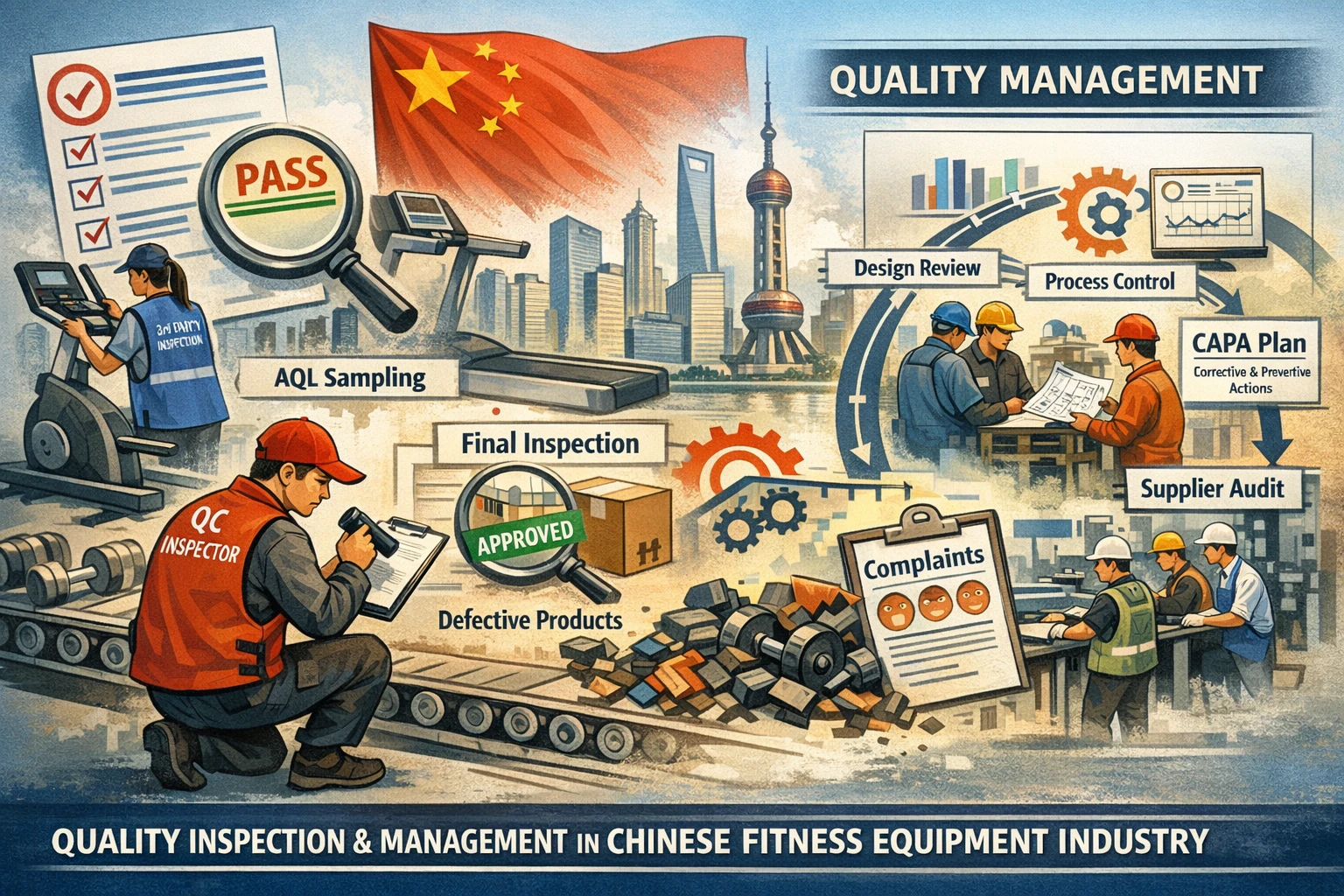
A truly effective quality system should be a multi-layer combination of design control, process control, supplier management, and final inspection, rather than relying on a single end-of-line gate.
For international sourcing leadership teams, instead of continually increasing Final Inspection frequency, it is often more effective to redesign the overall quality control structure. That is the key step in moving from “passive inspection” to “proactive quality management.”


![[Product Recall] Europe Recalls China-Made Kettlebells for Elevated Radiation Levels](https://www.fitgearsource.com/wp-content/uploads/2025/11/Action-Record-on-Kettlebell--300x182.webp)


Comments (0)
No comments yet, be the first to comment!