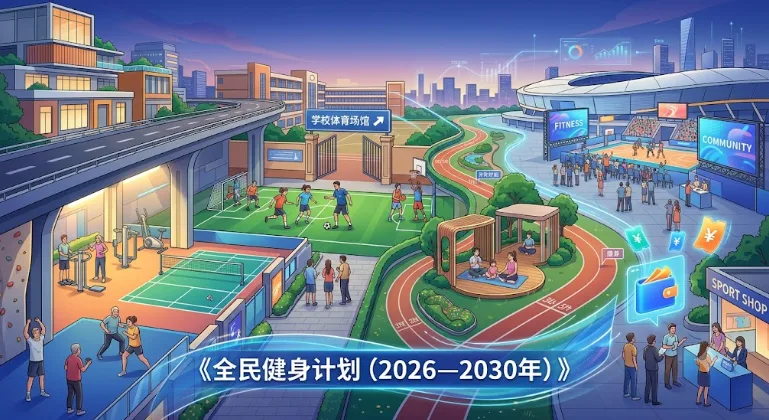
BEIJING (July 10, 2026) — China's State Council has officially executive-reviewed and approved the National Fitness Plan (2026–2030). The new blueprint outlines strategic directives to construct a higher-level public fitness service system across the country during the "15th Five-Year Plan" period.
Concurrently, the General Administration of Sport of China issued its 2026 Key Points for Mass Sports Work, signaling a coordinated national push toward grassroots sports infrastructure and localized wellness networks.
Core Strategic Focuses & Implementation Pillars
Localized Infrastructure ("Bottom-Up" Site Provision): Regulators are targeting urban "residual spaces"—such as retrofitting areas beneath elevated highways—to systematically expand fitness venue supply. Priorities will shift toward developing neighborhood-level, smart fitness pavilions, pocket parks, and multi-functional sports courts to alleviate constraints in aging residential quarters.
Integrated School-Community Resources: The State Council explicitly encourages the opening of campus sports facilities to the general public outside of school hours. The plan deepens integration between education and sports ecosystems, optimizing in-school physical activity blocks and championing a "School + Club" operational framework to foster lifelong athletic habits in youth.
Event Ecosystems & Economic Stimulus: Municipalities will broaden the rollout of mass sports tournaments and upgrade physical fitness outreach methods. To incentivize consumer participation, local authorities are deploying sports consumption vouchers, utilizing the grassroots fitness wave to anchor regional health economies.
Local governments nationwide are already accelerating the rollout of "10-Minute Fitness Circles," a structural metric aimed at ensuring every citizen has walkable access to sporting infrastructure while comprehensively advancing nationwide physical health metrics.