

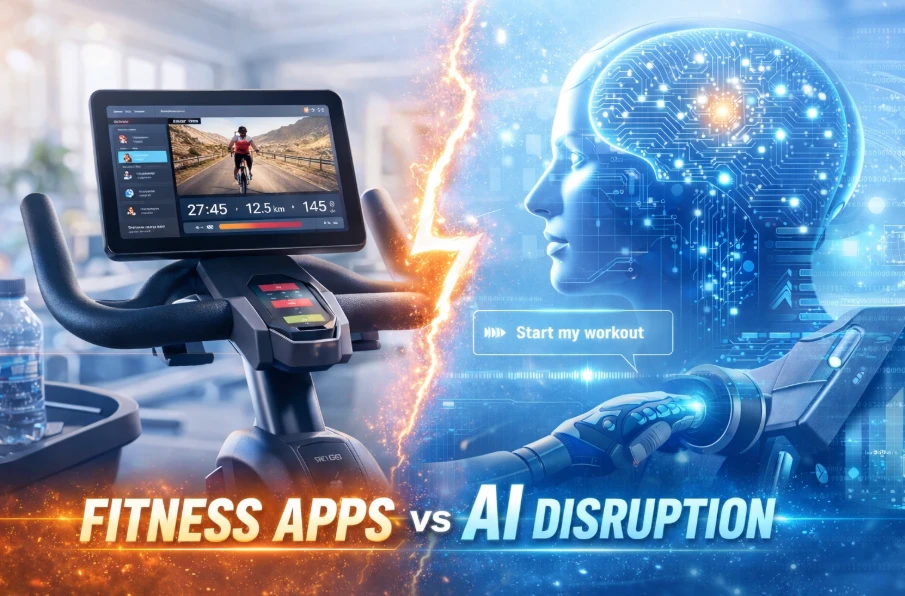
Introduction: AI Is Approaching, Not Yet Realized in Fitness Equipment World
Over the past decade, apps have become a standard component in the evolution of connected fitness equipment. Whether for treadmills, indoor bikes, or strength machines, building training content, data systems, and user engagement around an app has become an industry norm. In many cases, the app is not just an extension of the product—it is seen as the primary touchpoint between the brand and the user.
However, when we look beyond the fitness industry, a subtle but important shift is already taking place.
In the past year, AI applications have advanced rapidly across multiple sectors—from content creation and software development to service execution. Increasingly, users are no longer relying on the traditional path of “open an app → perform a series of actions.” Instead, they express their intent directly, and systems execute tasks on their behalf.
This shift has not yet significantly impacted the fitness equipment industry. But from a technological trajectory standpoint, it is highly likely to do so in the near future. And when it does, it may fundamentally reshape how fitness apps are used—or whether they are used at all.
Rather than waiting for that moment, it may be time to start asking: are we prepared for it?
Rethinking the Process: Do Users Really Need the “App Journey”?
Consider a familiar scenario. A user returns home after work and prepares for a cycling session. Today, the typical process involves opening an app, connecting the device, browsing workouts, selecting a suitable session, and then starting the training.
This workflow is logical—but also highly interaction-dependent.
If we break it down, much of the time spent in this process does not create new value. What the user truly needs is not the sequence of actions, but the outcome: what to train, how long, at what intensity, and whether it is safe and effective.
The app interface serves primarily as a translation layer. It converts a user’s intention into instructions that the system can execute. The taps, swipes, and selections exist because the system cannot directly understand the user’s intent.
But if AI can interpret natural language and generate a training plan based on historical data, then this translation layer may no longer be necessary. In such a scenario, the entire interaction model of fitness apps would need to be reconsidered.
What AI Changes: Not Capability, But Pathways
When discussing AI, much attention is often placed on enhanced capabilities—better recommendations, more accurate data analysis, or smarter coaching logic. However, in many industries, the more fundamental shift lies in how users reach outcomes.
Previously, users had to navigate interfaces step by step. In the future, they may simply express a goal, and the system will execute the process directly. This is not necessarily about having more data or better algorithms—it is about removing intermediate steps.
Applied to fitness, this could mean that instead of browsing and selecting workouts, a user simply says: “I feel a bit fatigued today, give me a recovery session.” The system then configures the training plan, adjusts resistance, and starts the session automatically.
While this is not yet a mainstream scenario in fitness, it is already emerging in other industries. As AI continues to evolve and integrates more deeply with hardware, this kind of interaction could become increasingly common.
The Nature of Fitness Apps: Functional, Not Experiential
The potential impact of this shift is particularly significant for fitness apps because of their fundamental nature.
Most fitness apps are designed to solve a specific problem: helping users train more effectively and safely. Users open them with a clear objective in mind—they are
























Comments (0)
No comments yet, be the first to comment!