

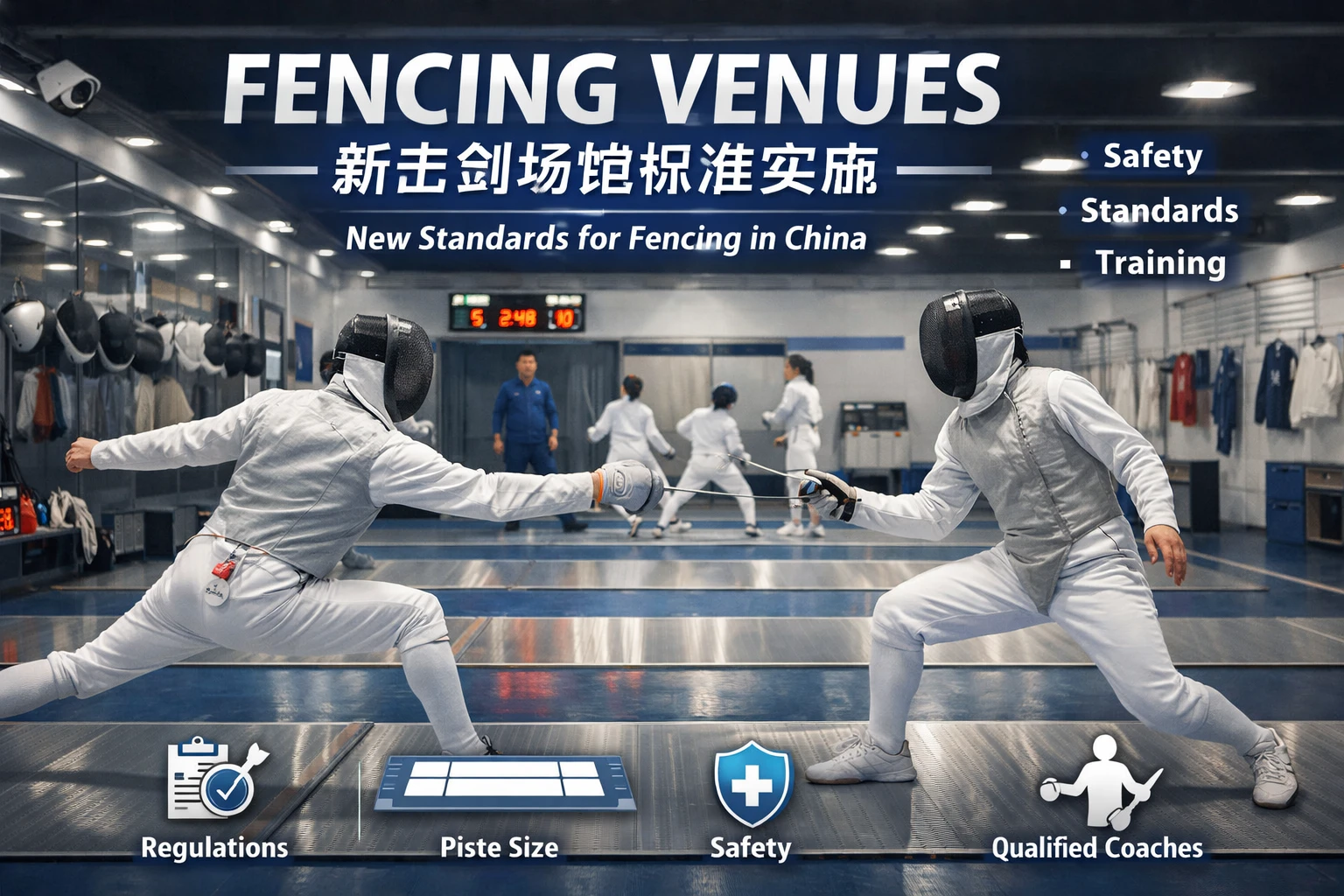
China has officially approved and released a new mandatory national standard, Sports Venue Open Conditions and Technical Requirements – Part 15: Fencing Venues (GB 19079.15—2025), marking a major regulatory milestone for the fencing sector.
According to Announcement No. 39 of 2025 issued by the State Administration for Market Regulation and the Standardization Administration of China, the standard will come into force on July 1, 2026. Its release fills a long-standing regulatory gap, as China previously lacked a mandatory national standard specifically governing fencing venues.
The standard was proposed and administered by the General Administration of Sport of China and led by the China Institute of Sport Science. The drafting process involved multiple institutions, including the Sports Equipment and Facilities Center of the General Administration of Sport, the Chinese Fencing Association, and China Jiliang University.
In recent years, China’s fencing training market has expanded rapidly. However, unclear entry thresholds and uneven management practices have emerged across the sector. Some venues show significant deficiencies in coaching qualifications, facility conditions, and safety management, resulting in inconsistent service quality and early signs of “bad money driving out good.” As a confrontational sport involving hand-held metal weapons, fencing carries inherent injury risks if not properly regulated. The absence of a dedicated mandatory standard has made it difficult to ensure baseline safety and quality across the industry.
The newly issued standard establishes the basic conditions and technical requirements that all fencing venues open to the public must meet. Its scope covers personnel qualifications, venue layout, facilities and equipment, hygiene standards, and safety assurance systems. The standard specifies requirements for the staffing of qualified fencing coaches, sets a minimum training-area size of no less than 180 square meters, and defines detailed technical criteria for piste dimensions, flooring materials, lighting and surveillance systems, and equipment safety. It also requires venues to establish comprehensive safety management systems and emergency response plans.
Once implemented, GB 19079.15—2025 will provide fencing participants with safer and more professional training environments, offer venue operators clear and unified guidelines for construction and operation, and give regulators a consistent enforcement benchmark. Overall, the standard is expected to guide China’s fencing industry away from unregulated expansion toward a new phase of high-quality, standardized development, strengthening the foundations of the country’s national fitness strategy and broader ambitions to build a strong sports nation.
Source: the General Administration of Sport of China























Comments (0)
No comments yet, be the first to comment!