

Key Insights from the 2025 China Fitness Industry Data Report
During the 2026 IWF Shanghai International Fitness Expo, the 2025 China Fitness Industry Data Report was officially released. The report was jointly compiled under the guidance of the China Bodybuilding Association, with contributions from Shanghai University of Sport’s School of Economics and Management, 3T Cloud Motion, and the IWF Shanghai International Fitness Expo.
The report provides a comprehensive overview of the development of China’s sports and fitness industry in 2025, combining industry data, academic research, and market insights. From a macro perspective, the industry appears to be transitioning from a phase of rapid expansion toward structural optimization and quality-driven growth.
While the number of venues, members, and practitioners has declined slightly, several positive structural trends are emerging, including increased user engagement, evolving consumption patterns, and rising market concentration.
Fitness Venue Numbers Decline Slightly as Market Structure Adjusts
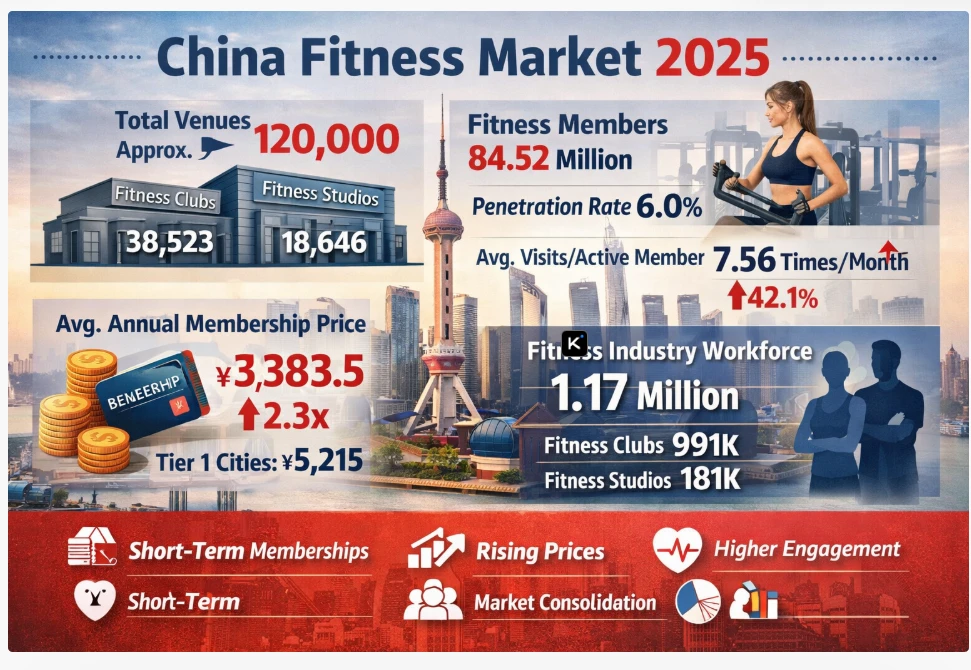
According to the report, by the end of 2025, China had approximately 120,000 fitness-related venues in the broad sense, representing a decline of about 23,000 venues compared with 2024.
The structural composition of the market has also shifted:
- Fitness clubs: 38,523
- Fitness studios: 18,646
The data suggests a gradual rebalancing of the market. After several years of rapid studio expansion, the industry is now experiencing a consolidation phase, leading to a more rational allocation of facility resources.
Membership Numbers Dip, but Core User Engagement Rises
In 2025, the total number of fitness members in China reached 84.52 million, representing a 3.44% decline year-on-year. The overall fitness membership penetration rate stood at approximately 6.0% of the population.
However, user engagement indicators reveal a different trend.
- Active members’ average monthly gym visits: 7.56 times
Up 42.1% year-on-year
- Average visits among all members: 2.63 times per month
This indicates that although the overall membership base has slightly contracted, core users are exercising more frequently, suggesting a strengthening of long-term fitness habits among committed participants.
Short-Term Memberships Become the Dominant Consumption Model
Another notable trend in 2025 is the shift toward lighter and shorter membership commitments.
Data shows:
- In fitness studios, memberships of one year or less accounted for 97.1% of total memberships.
- In traditional fitness clubs, the share of such short-term memberships reached 85.34%.
This shift reflects both consumer risk awareness and operators’ evolving business strategies, as the industry gradually moves away from long-term prepaid membership models tow

















Comments (0)
No comments yet, be the first to comment!