

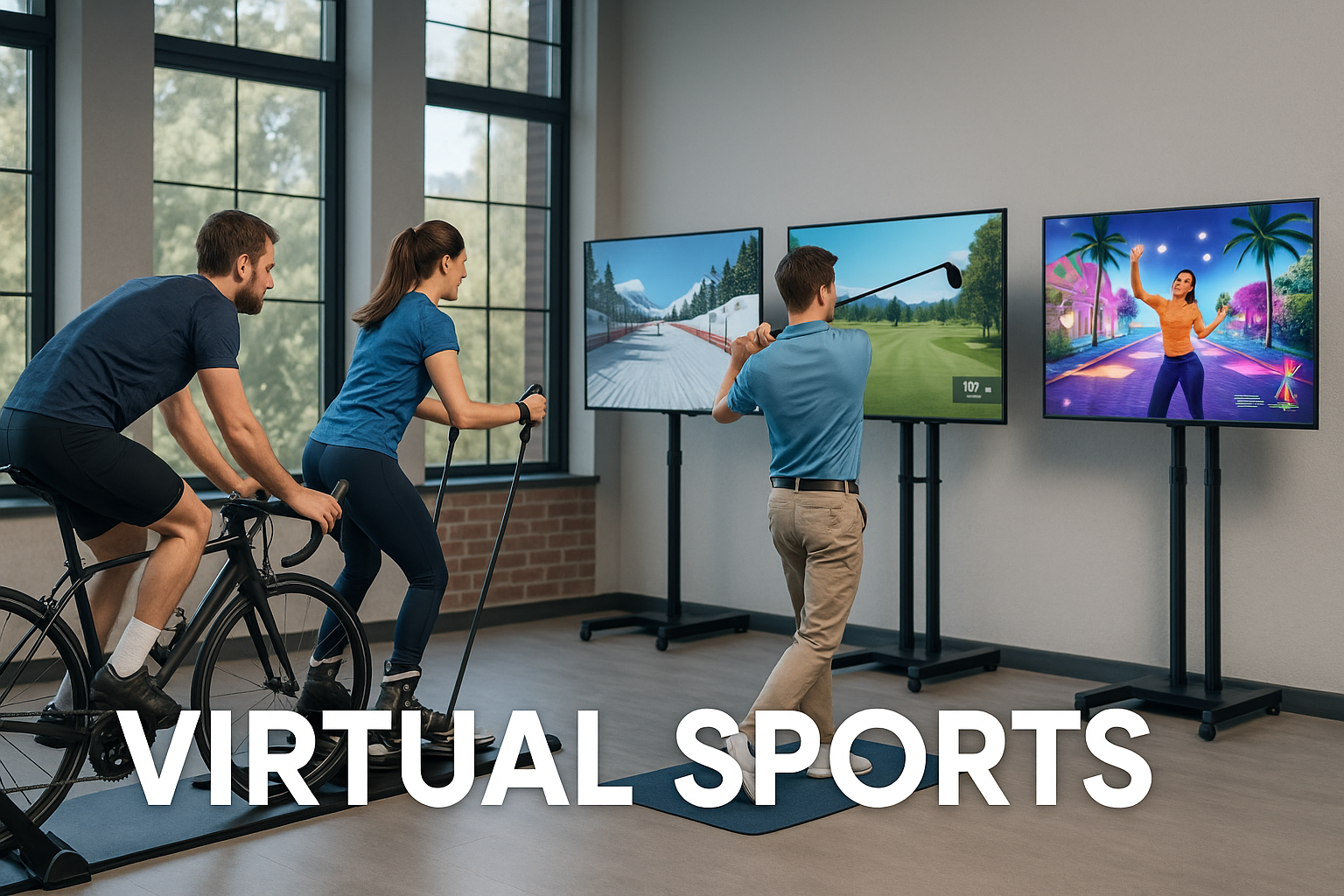
The Concept of Virtual Sports
Virtual sports represent a new form of digital sports driven by cutting-edge technologies. Broadly, it refers to all kinds of sporting activities conducted within virtual environments. Narrowly, it emphasizes immersive participation and practical application of athletic skills, powered by VR, AR, MR, AI, IoT, and digital twin technologies.
Unlike traditional sports, virtual sports competitions break through limitations of venues, environment, or physical conditions, enabling athletes and amateurs alike to participate from anywhere. Platforms also embed strong social interaction functions, allowing players to compete, train, and connect with others worldwide in real time, enhancing stickiness and community engagement.
Key Features of Virtual Sports
1. Interactive Virtual-Physical Integration – Athletes interact with avatars in a digital environment that responds instantly to user actions, creating dynamic and personalized experiences.
2. Convenience and Accessibility – Digital technologies reduce participation thresholds, overcoming barriers of time and location.
3. Strong Social Attributes – Virtual sports platforms encourage collaboration and competition, building networks of participants and enhancing brand and industry value.
China’s Virtual Sports Market and Industry Growth
In recent years, China’s virtual sports market has grown rapidly thanks to supportive policies and technological innovation. The IOC Olympic Agenda 2020+5 explicitly encouraged virtual sports, while domestic policies such as the National Fitness Plan (2021–2025) recognized and supported their development.
According to industry data, in 2024 the Chinese digital sports market grew by 25.7% year-on-year, with projections showing the industry could reach RMB 115.2 billion (USD 16 billion) in 2025.
Core hubs such as Shanghai, Beijing, Qingdao, Chongqing, Hangzhou, and Jinjiang have hosted landmark virtual competitions, covering disciplines such as virtual cycling, virtual rowing, virtual racing, virtual golf, virtual skiing, digital karting, and intelligent treadmill events. These cities are shaping a diverse, multi-layered virtual sports ecosystem.
Insights into Participants and Competition Trends
(1) Growth of Participant Base
The Shanghai Virtual Sports Open (SVS) is a prime case study. Participation rose from 11,000 people in 2022 to 32,933 in 2024, nearly a threefold increase. This surge was driven by new competition formats (e.g., elite pairing matches, college leagues) and aggressive offline promotion campaigns.
(2) Competition Cycles and Frequency
Event frequency shows a shift toward quality over quantity. SVS held 68 events in 2022, but only 44 in 2024. Despite fewer events, the number of participants and engagement rose, reflecting a “premiumization” strategy where organizers prioritize brand value and experience over sheer volume.
(3) Gender Structure Analysis
Gender balance is evolving. In the virtual skiing category, male participation rose from 57% in 2023 to 62% in 2024. Analysts suggest this is due to the strength- and speed-oriented nature of the event, which aligns more closely with male participants, while women tend to favor more skill-based sports.
(4) Distribution and Trends of Virtual Sports Disciplines
• Virtual cycling: Early rapid growth has slowed due to market saturation.
• Virtual racing: Explosive growth; cumulative participation exceeded 20,000 players by 2024, ranking first among all projects.
• Virtual skiing: Participation remains stable.
• Virtual golf and rowing: Participation grew modestly but limited by smaller real-world participation bases.
Recent Examples of Digital Sports Competitions
1. Shanghai Virtual Sports Open 2024
o Duration: April–December 2024
o Disciplines: Virtual cycling, virtual F1, virtual skiing, virtual golf, virtual dance, virtual taekwondo, etc.
o Highlights: Covered 10 countries, drew over 130,000 participants, and attracted more than 500 million views. Introduced “dual-track points” linking offline and online competitions for skiing, rowing, and cycling.
2. Beijing Digital Sports Open 2024
o Organized by Beijing Sports Bureau, featuring virtual cycling, digital golf, and rowing.
o Adopted self-developed AI-based management systems, digital twin landscapes (e.g., Chang’an Avenue, Shougang Park), and immersive gameplay, attracting nearly 10,000 competitors and over 200 million online views.
3. Yellow River Basin & Jiaodong Five Cities Digital Sports Games 2023
o Included over 20 virtual events such as intelligent cycling, simulated golf, esports racing, and cloud climbing.
o Focused on regional collaboration and digital integration, linking sports with local economic development.
4. Chongqing Metaverse Community Games 2023
o Core project: digital road cycling.
o Combined 5G, VR, and digital twin technologies with community-level events, attracting star athletes like world champion Zhang Yawen, and promoted the idea of “sports metaverse for all.”
Conclusion
Virtual sports and digital sports competitions are reshaping the sports industry in China. With fast-growing participation, event innovation, and a diverse ecosystem, virtual sports are bridging traditional athletics with cutting-edge technologies.
As policies encourage expansion and platforms refine immersive competition formats, China is positioned to lead in global virtual sports markets, attracting stakeholders across manufacturing, events, esports, and fitness industries.
The industry is expected not only to reach massive economic value but also to create a sustainable model of sports + technology + community, making virtual competitions a new growth engine for both sports participation and digital economy development.




![[Smart Technology] OpenAI Launches ChatGPT Health: AI Enters the “Health Interpretation Layer,” Potentially Redefining the Fitness Equipment & Smart Device Industry](https://www.fitgearsource.com/wp-content/uploads/2026/01/CHATGPT-Health-Launched--300x198.webp)










![[Smart Technology] OpenAI Launches ChatGPT Health: AI Enters the “Health Interpretation Layer,” Potentially Redefining the Fitness Equipment & Smart Device Industry](https://www.fitgearsource.com/wp-content/uploads/2026/01/CHATGPT-Health-Launched-.webp)







Comments (0)
No comments yet, be the first to comment!